
Leaders: Carole Catling, Alan Feest and Helena Crouch
For the 2026 Festival of Nature, Bath Natural History Society provided support to the Friends of Moorlands Park for a day of celebration of nature in the park. The planned programme began with moth trap opening, to be followed by a biodiversity survey and wildflower walks. In the afternoon, Hugh Williamson of Bath Urban Treescape led a tree trail walk, Rob’s Route, a three-mile walk between Moorlands Park and Alexandra Park, named after our past Bath Nats President, Rob Randall.
The weather outlook was most unpromising, with heavy and persistent rain forecast overnight and into the next day: this proved to be the case. As the event was publicised, the decision was made to go ahead with the traps, despite the forecast.
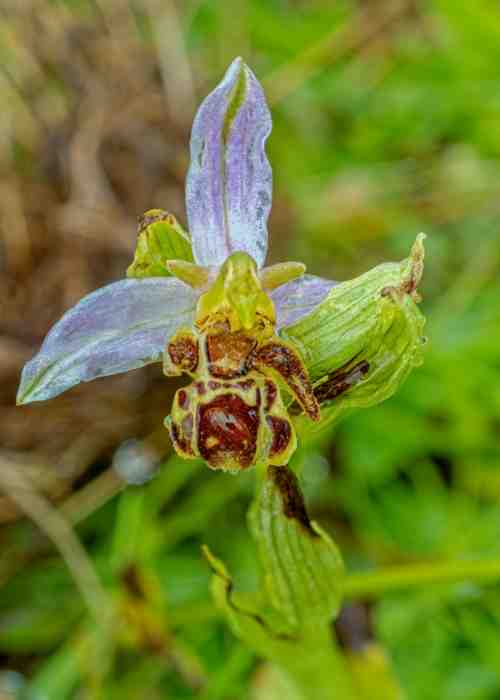
The drenched Bee Orchid in Moorlands Park © Mike Williams
Two moth traps, one Actinic and one Mercury Vapour, were run overnight in gardens opposite the park and brought into the park itself for opening at 09:00. The weather was off-putting but eight of us gathered, including two very interested children and it was good to see them so engaged.
We were pleased that we had enough moths to look at, 66 in total with Heart and Dart moths being the most common, we had 29 of these. The next most common moth was the Treble Lines, 11 of these. There were no ‘star’ moths like the Hawk-moths which are always eye-catching for members of the public, but we had enough to keep us occupied, including identification of some of the micro moths like the Cypress Tip Moth, Argyresthia cupressella. Many thanks to Anne Crowe and Glen Maddison for helping with identification of the moths.
During the moth session, we were fortunate to experience only occasional light drizzle, but the rain did not hold off for long. Only two members accompanied Alan and Helena to the East Field. Here we had a walk to look at the botanical diversity of this amazingly species-rich area, discussing the reasons for variations in diversity across the field. The most botanically diverse area is the steepest slope, where we saw Quaking-grass, Mouse-ear Hawkweed, Bird’s-foot-trefoil, Hoary Plantain and Glaucous Sedge, all species of unimproved calcareous grassland.
A single Common Spotted-orchid was looking tattered but we were delighted to find a smart Bee Orchid. Unfortunately the promised heavy rain began in earnest, so by mutual agreement, with so few members attending and nobody from the Friends of Moorlands Park or the neighbourhood, we chose to finish the event.
Carole Catling & Helena Crouch
Recent Comments