
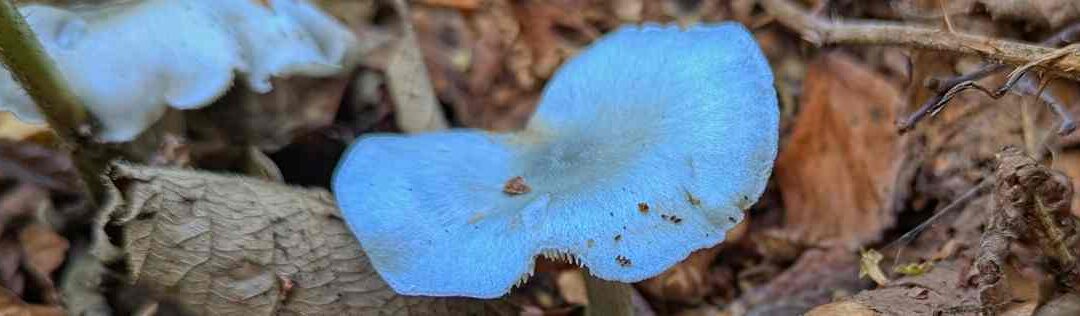
Above: Aniseed Funnel (Clitocybe odora) © Helena Crouch
Leaders: Alan Rayner and Helena Crouch
It was unseasonally mild as 16 of us assembled for a fungal foray in Greyfield Wood, near High Littleton. Greyfield Wood is owned by the Woodland Trust and has mixed geology and a good variety of tree species, providing varied habitats for fungi. After the summer drought, the woodland was very dry.
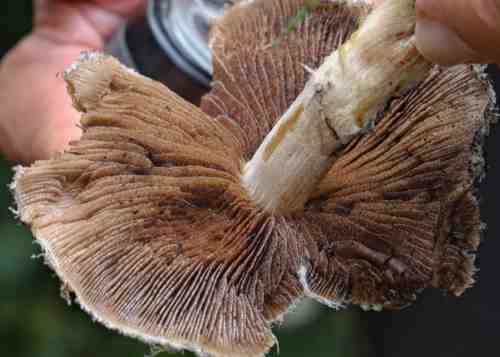
Weeping Widow (Lacrymaria lacrymabunda) © Richard Bottle
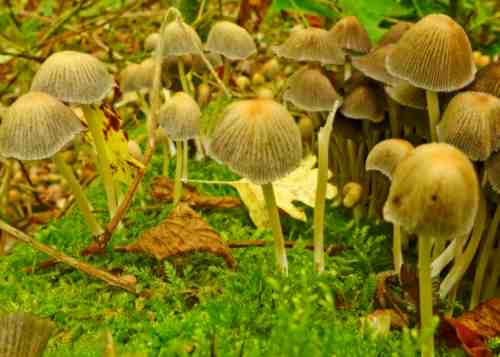
Glistening Inkcaps (Coprinellus micaceus) © Helena Crouch
The first species examined was Rusty Woodwart (Hypoxylon rubiginosum), a reddish crust on an old ash log. Nearby we also found Hazel Woodwart (H. fuscum) and later the related Beech Tarcrust (Biscogniauxia nummularia). Some tiny grey discs on a tree trunk were identified as the Common Grey Disco (Mollisia cinerea), their beauty best appreciated using a handlens. These are all ascomycetes, growing on dead wood: Alan explained that Hazel Woodwart develops endophytically within a living tree, emerging on the surface when a branch becomes stressed or dies.
The first toadstool found was a Deer Shield (Pluteus cervinus) which has pink gills and grows on decayed wood. A tiny delicate specimen was thought to be a Horsehair Parachute (Marasmius androsaceus). These also grow on plant debris. Another tiny specimen could only be identified as one of the Bonnets, but we soon found the distinctive Blackedge Bonnet (Mycena pelianthina) with dark edges to the gills and smelling of radishes. Later we also found a Snapping Bonnet (M. vitilis), with a stiff stipe which snaps audibly, and Grooved Bonnet (M. polygramma) with a distinctively grooved stipe.
Under Beech trees by the path, several boletes were found, encrusted with white mould. These were Red Cracking Boletes (Xerocomellus chrysenteron). Later we found the closely related Bluefoot Bolete (Xerocomellus cisalpinus), only recently recognised as a separate species. Boletes are large distinctive fungi without gills: instead, they have a spongy undersurface comprising many tubes down which the spores are dropped. We also found a Suede Bolete (Xerocomus subtomentosus) with yellow flesh and, under Birch, a Brown Birch Bolete (Leccinum scabrum) with dark fibres on the stem and a pale brown cap.
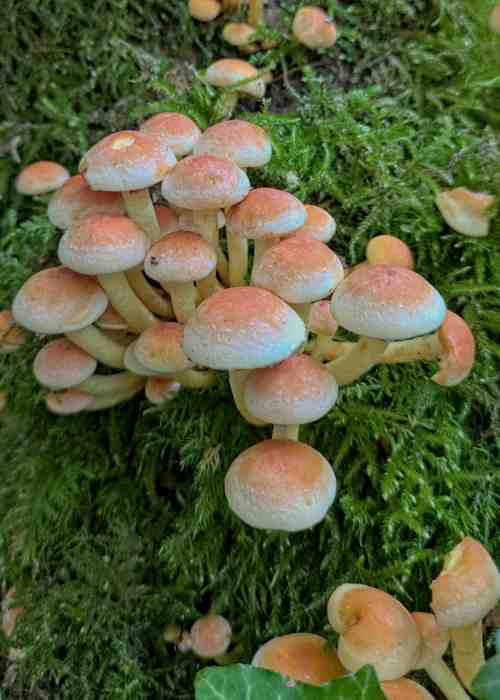
Sulphur Tuft (Hypholoma fasciculare) © Helena Crouch
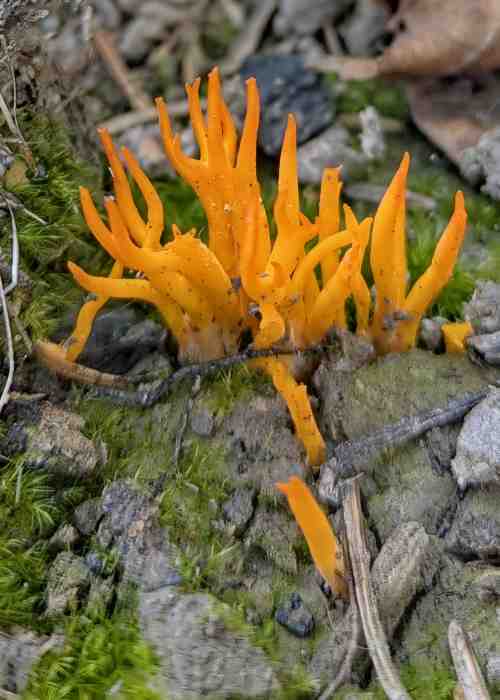
Yellow Stagshorn (Calocera viscosa) © Helena Crouch
A troop of beautiful blue fungi growing under trees were Aniseed Funnels (Clitocybe odora) which some members agreed smelt strongly of aniseed. Another distinctive species by the path was the Weeping Widow (Lacrymaria lacrymabunda), with blackened gills weeping tears. Clumps of Sulphur Tuft (Hypholoma fasciculare) were emerging from a rotten stump and King Alfred’s Cakes (Daldinia concentrica) were found on a fallen Ash branch. Alan explained how the ascospores, which develop within perithecia just below the surface of the fruiting body, are spectacularly ejaculated by a build-up of water pressure within the ascus.
More colourful fungi were found, including Purple Brittlegill (Russula atropurpurea), Yellow Stagshorn (Calocera viscosa), a Blueing Bracket (Postia subcaesia), a group of dull brown Clustered Toughshanks (Collybia confluens) and a swarm of Glistening Inkcaps (Coprinellus micaceus), covered in dense shining flecks like mica.
Perhaps the most intriguing and bizarre fungus found was the Blushing Rosette (Abortiporus biennis). We found this in several places, growing on the ground, attached to buried wood. This strange bracket fungus has two forms: an amorphous cauliflower-like white blob exuding red droplets, and a pretty fan-shaped bracket. We mostly found the former, but only the latter is illustrated in field guides.
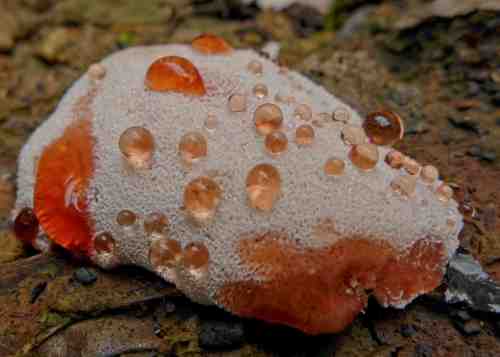
Blushing Rosette (Abortiporus biennis) © Helena Crouch
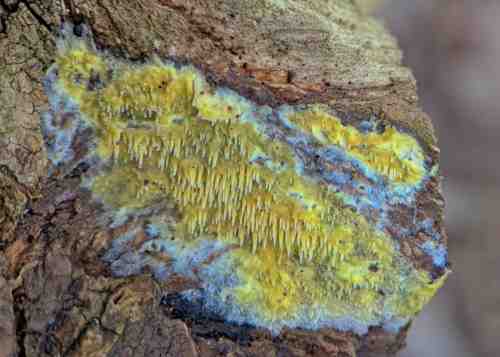
The yellow resupinate fungus Mycoacia uda © Helena Crouch
After a convivial stop for lunch, Alan showed us a resupinate fungus, Mycoacia uda, forming a yellow patch on the underside of a fallen branch. Under a hand lens, the surface was seen to be densely covered with long thin spines. Resupinate fungi have their fruit bodies flattened against the substrate rather than protruding from it like a bracket. Crusts are mostly flattened but with the edges turned up: we found some rather desiccated Bleeding Broadleaf Crust (Stereum rugosum) and the common, multicoloured classic bracket, Turkeytail (Trametes versicolor).
Before leaving the wood, we ventured along a small path leading southeast from the car park, hoping for a few more species. A large round white “egg” was sliced in half to show the developing fungus within: a Stinkhorn (Phallus impudicus). A plain pale brown toadstool with a slimy cap was identified as Poisonpie (Hebeloma crustuliniforme), a poisonous species, smelling strongly of radishes. We also found a Pale Brittlestem (Psathyrella candolleana), False Chanterelle (Hygrophoropsis aurantiaca) and a Sepia Brittlegill (Russula sororia). Despite the drought, we had found a good selection of interesting fungi and all enjoyed a meeting packed with fascinating information.
Helena Crouch
Recent Comments