
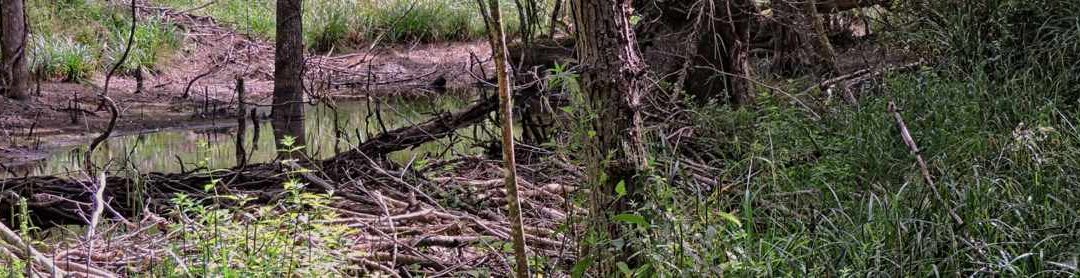
Above: Beaver Dam at Longleat © Alvan White
Leader: Dr Thomas Lewis (Conservation and Research Manager)
We welcomed new members the Carr family, Katie Chapman, and Richard Hanahan.
The meeting was an intriguing one, covering much more than the Beavers on the estate. Tom gave a talk on the wildlife at Longleat and responded to questions.
Habitats included short and long grassy areas (only a top brush cut given in recent time), the latter creating a prairie full of singing grasshoppers and crickets. It looked ideal habitat for Wasp spiders, but it was not known whether they were present.
The estate practised a continuous cover policy for the trees, although thinning was carried out that produced a thriving firewood market. It also enabled sunlight and growth to produce glades in the forest beneficial to plants and all life in the food chain.
Natural tree regeneration was allowed to take place.
Larch trees had been attacked by the fungal Phytophthora ramorum, known as larch disease, which is spread by spores carried in water and moist wind. It produces needle loss, shoot dieback, and cankers on the trees. The disease can spread rapidly, sometimes killing trees within a couple of growing seasons. The infected trees were felled, in line with government advice.
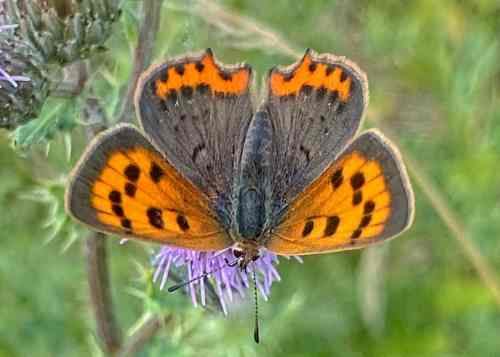
Small Copper © Phillip Delve

Meadow Brown (females)
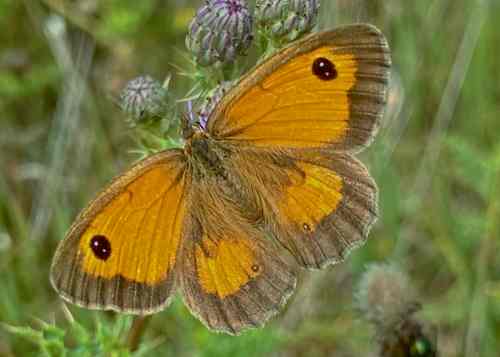
Gatekeeper (female) © Phillip Delve
The woodland rides and grasslands produced many butterfly species and several iconic Silver-washed Fritillaries were observed. Also noted were Small Coppers, Small Skippers, Ringlets, and Meadow Browns.
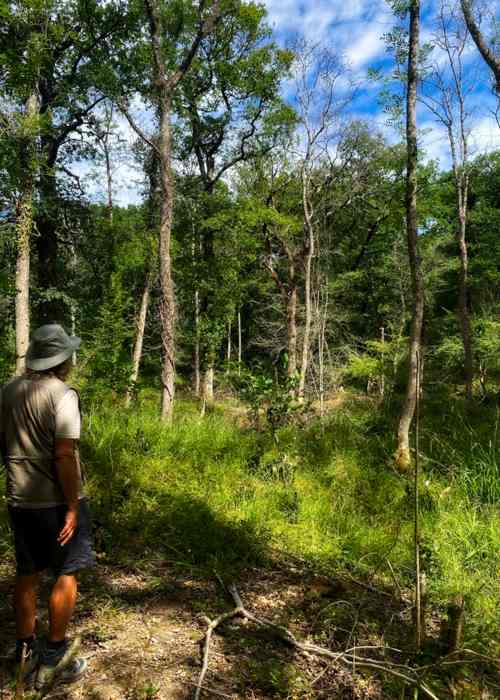
Beaver glade © Phillip Delve
Glen also found a Dingy Footman moth. Some saw what was considered a possible Clouded Yellow, but this was not confirmed.
The dense scrub prior to reaching the Beaver site was pointed out and compared to the dramatic cleared areas made by the Beavers. Gnawed off young trees and bushes were everywhere. An oak tree of quite some size had been partially ring barked.
Beavers here have a preference for Poplar trees. They eat tree bark and leaves, being purely vegetarian.
Noticeable were the dams, and lodges. One lodge is used specifically by the female to raise her kits. The males are solitary while this happens. Beaver mothers can have up to 4 kits at any one time and their life span is over 20 years.
Dams are built with mud and stones which are rammed into the walls. Side channels are dug out, and serve as protection against predators and a useful corridor for floating logs down into the main pond. A winter larder is made, with food stored near the lodge and under water.
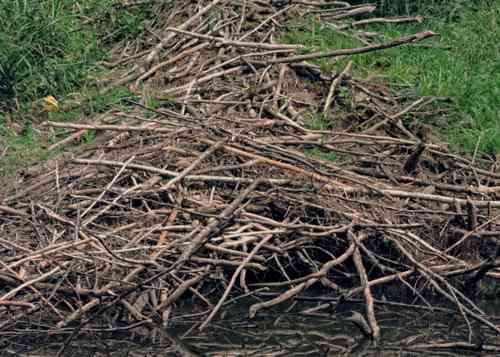
Beaver Lodge © Alvan White
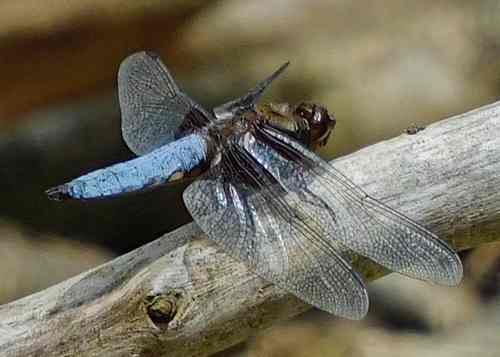
Broad-bodied Chaser © Catherine Turner
Other sites, including the Hippo lake at Longleat, have attracted Beavers. They are now in the River Wylye catchment that runs down towards Salisbury. Close by are the Beavers at the Heal rewilding site.
There were not many odonata present but two Broad-bodied Chasers were found at the Beaver ponds.
There is a rich diversity of wildlife. Mammals also include Pine Martens, Wild Boar, Fallow and Muntjac deer. A possible Pine Marten scat was found on a log.

Larvae and chrysalis case © Alvan White
.
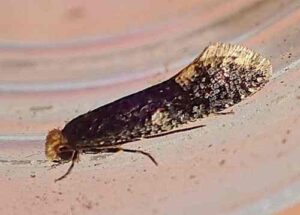
Carrion Moth Monopis weaverella © Alvan White
Catherine found what was initially thought to be a pellet with a jaw bone of a rodent buried within, regurgitated by a bird of prey. Further consideration made me think it was more likely to be the scat from a fox. It had quite a bit of grey/silvery hair ending in a twist, with a very crumbly texture. Both are evidence of a fox, the latter possibly from the gut in earthworms.
At home, I opened the pot containing the scat to find three micro moths within. Chyrsalis cases were present as well as very small larvae. The moths were found to be Carrion Moths, Monopis weaverella, that feed on faeces (and animal carcases).
Birds heard and seen included the call of young Goshawk (2 in nest), Spotted Flycatchers, Siskin, Marsh Tit, Kingfisher, Grey Wagtail, Treecreeper, Goldcrest, Blue Tit, and Robin.
A Redstart had been seen close to the car park. Recent sightings have been made of White-tailed Eagles, thought to be from the reintroduction at the Isle of Wight.
A very interesting visit and one which we to hope to follow on.
Alvan White
Recent Comments