
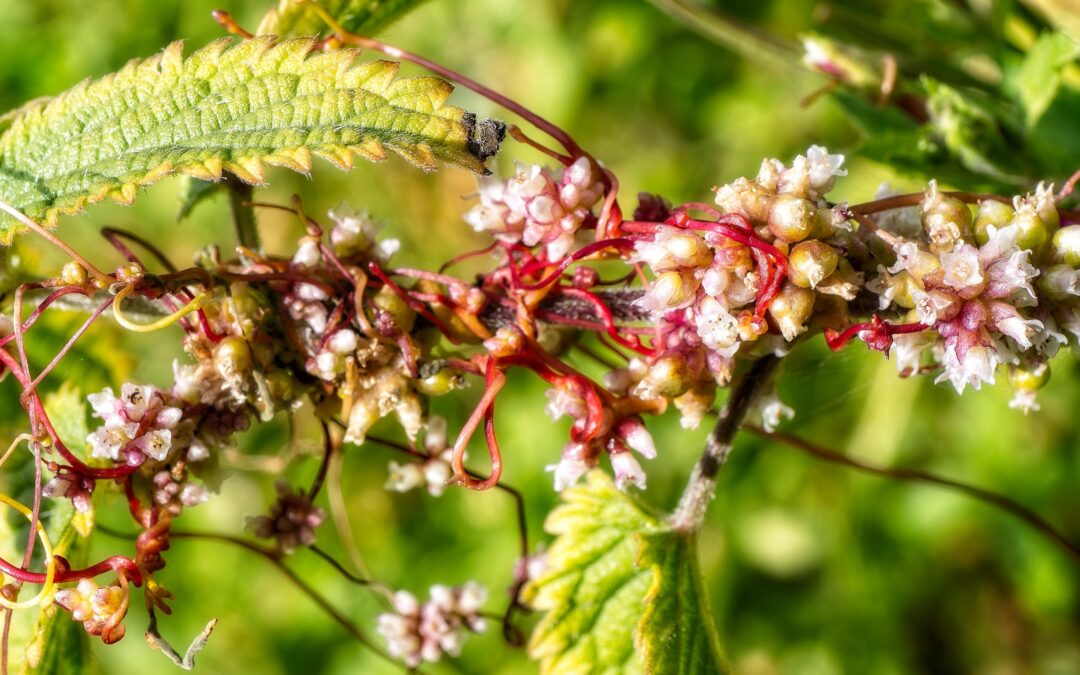
Above: Greater Dodder at Watership Farm © Mike Williams
Leader: Alvan White
The survey of Watership Farm has become an annual event: five of us assembled to continue exploring this rich but private site, welcoming a new member to her first BNHS survey. Watership Farm comprises several habitats including dry grassland, marshy areas below a springhead, a riverside meadow and riverbank, and a long narrow slope rich in tall herbs, many of them in flower for our visit.
We headed for the large riverside meadow as this was not surveyed in 2024. Two cattle were grazing the herb-rich slopes. Progress was slow as there was a lot to take in. We were pleased to find about 20 statuesque plants of Small Teasel (Dipsacus pilosus) in flower.
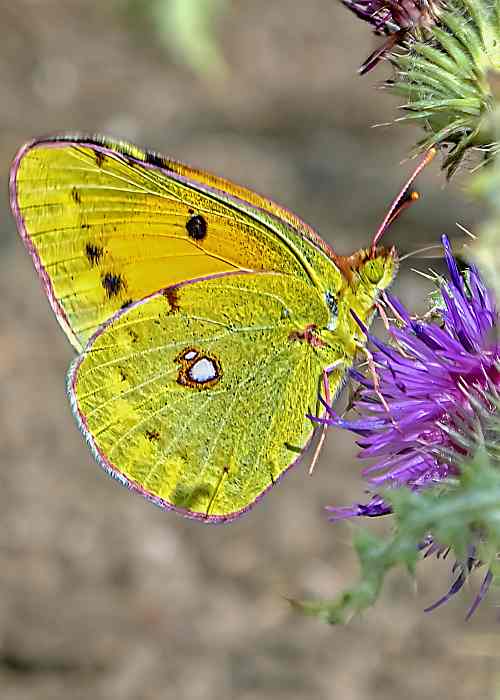
Clouded Yellow © Mike Williams
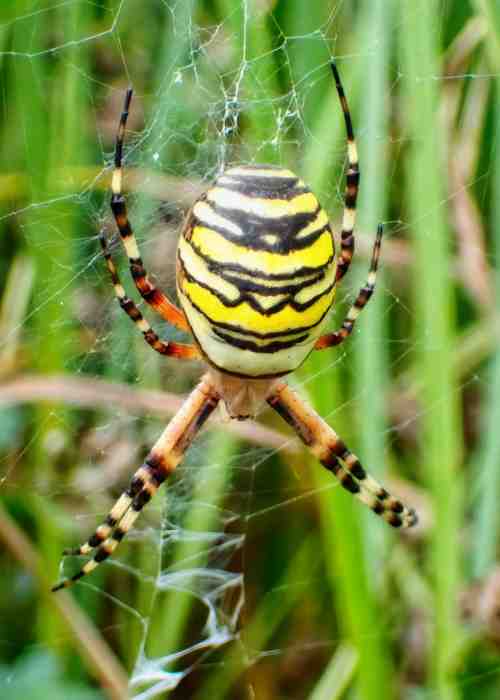
Wasp spider © Catherine Turner
Excitingly, a Clouded Yellow was spotted (following a potential sighting at our Longleat meeting two weeks previously). This beautiful yellow butterfly edged with black is a migrant from the continent. Larval food plants include clovers, but winter temperatures are currently too cold for survival of the caterpillars.
The riverside meadow is accessed through challenging gates under a railway bridge, where we found large patches of twining red stems of Greater Dodder (Cuscuta europaea), a species parasitic on nettles or hops. The long, uncut riverside meadow, looked very brown after the extended dry period. Amongst other species were patches of thistles, Purple Loosestrife (Lythrum salicaria), and Marsh Woundwort (Marsh Woundwort) in flower. More patches of Greater Dodder were found on nettles along the base of the railway bank. Multitudes of crickets and grasshoppers jumped aside as we walked: bush-bashing and sweep-netting produced Speckled Bush-cricket (Leptophyes punctatissima) and Roesel’s Bush-cricket (Roeseliana roeselii).
Catherine was the first to find a Wasp Spider (Argiope bruennichi), followed by Four-spotted Orb Weaver (Araneus quadratus). Both species were numerous and seen with grasshoppers and crickets in their webs. They were observed tying up their prey in threads and eating them. These are two of the largest spider species in the UK by weight. It was noticeable that the Wasp Spiders were using the edge of a large patch of Greater Pond Sedge within a marshy area. Helena explained that this marked the edge of a spring that seeped under the railway line. It is likely that the undisturbed Sedge has contributed to the large numbers present, as these spiders attach their egg sacs low down in the grass. The egg sacs overwinter, and the young hatch out in the Spring. However, any trampling or harvesting of the grass will likely destroy these egg sacs. Watership Farm may be one of the largest “colonies” of Wasp Spider in the Bath area due to the overall undisturbed nature of the land. Catherine has observed that there are many more sightings of Wasp Spiders this year compared with previous years, suggesting that the warmer, dry weather suits them. Ten years ago, there were no Wasp Spiders around Bath. The species was first recorded in the UK in the 1920s in Southern England but is now spreading northwards as warmer weather becomes more prevalent. Mike found the first few in Bath in 2019 and they have since spread.
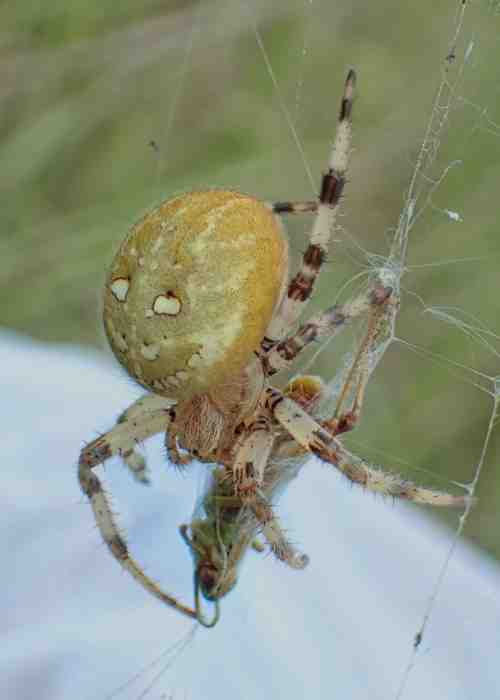
Four-spot Orb-Weaver © Catherine Turner
Many other arachnid species were recorded. Catherine found a Snake-back Tube-web Spider (Segestria senoculata) and Black Laceweaver (Amaurobius ferox) in the tunnel under the railway track. Helena spotted a distinctive web amongst the rushes which was identified as that of the Labyrinth Spider (Agelena labyrinthica). Two spiders found by Alvan were identified as a Metellina species and a Gorse Orb Weaver (Agalenatea redii). A single immature Humped Orb-weaver (Gibberanea gibbosa) was beaten from an Alder by Mike.
In the grassy meadow the following species were also found: Goldenrod Crab Spider (Misumena vatia), Garden Spider (Araneus diadematus), a wolf spider (Pardosa sp.) and a Furrow Orb-weaver (Larinioides cornutus).

Nursery-web Spider © Catherine Turner
A female Nursery-web Spider (Pisuara mirabilis) was found carrying her egg sac on Mike’s backpack and was carefully relocated to safety. The variety of Spiders indicates a good range of prey species, suggestive of a healthy ecosystem.
Returning to the herb-rich slopes north of the railway, more butterflies were spotted, including Brown Argus, Common Blue and Small Copper. A large orange butterfly suddenly appeared over the hedge line and immediately disappeared. Alvan and Paul immediately exclaimed “Fritillary”, a likely Silver-washed Fritillary from the woods over the river. Other butterflies seen were Peacock, Speckled Wood, Comma, Red Admiral, Large White, Meadow Brown and Gatekeeper, so including the Clouded Yellow we saw 12 species. Moths included a Straw Dot and a Blood-vein.

Blood-vein © Mike Williams
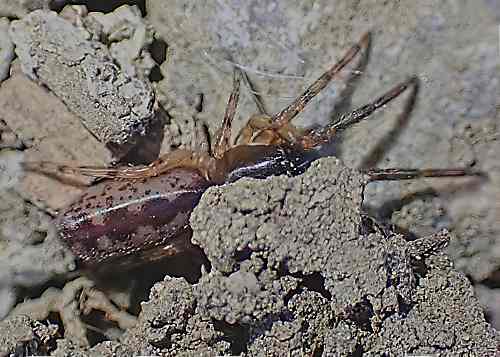
Snake-back Spider © Catherine Turner
Helena provided an excellent opportunity to study the inhabitants of a cow pat, when she inadvertently stepped in one. The highlight was the large and patterned rove beetle Ontholestes murinus. Nearby, we also found Bloody-nosed Beetle, which was peculiar given the lack of bedstraws, however they may have been feeding on Crosswort (a related plant), which was present.
At least twenty bird species were seen or heard, including a Marsh Tit and a Kingfisher. We recorded three galls: the swollen stems of Creeping Thistle, caused by the small but striking Thistle Gall Fly (Urophora cardui), Robin’s Pincushion galls on roses caused by the Bedeguar Gall Wasp (Diplolepis rosae) and large yellow blisters on the surface of Walnut leaves caused by the Walnut Leaf Gall Mite (Aceria erinea).
Odonata were thin on the ground, but both male and female Banded Demoiselles were seen near the river. Mike captured a White-legged Damselfly, and there were continuous sightings of a Brown Hawker.
A number of specimens were retained for subsequent identification, the most interesting being the mirid bug Globiceps flavomaculatus, probably a new species for the Bath area. Other species of note included the solitary wasps Ectemnius rubicola and E. lituratus, the sawflies Athalia rosae and A. circularis, and the tachinid flies Panzeria consobrina and P. rudis.
Report by Alvan White, Catherine Turner, Helena Crouch and Mike Williams
Recent Comments