

Above: Stoney Littleton longbarrow © Catherine Turner
Leaders: Catherine Turner, Paul Barton, Karen Funnel, John Garrett
Walking down the narrow lane to Stoney Littleton car park we saw a pheasant. On arrival the rain started to come down heavily and most of the local wildlife tucked itself away. We observed several species of fungi on the side of the grazed field leading up to the barrow.
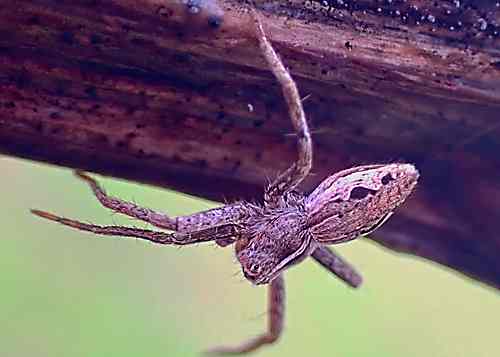
Pisaura mirabilis © Catherine Turner
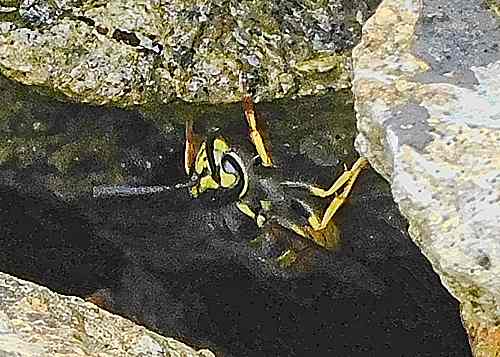
Vespula germanica © Catherine Turner
As we trudged through the rain Catherine split open a dead, hollow plant stem to demonstrate the many silk retreats of spiders inside, and a young Pisaura mirabilis (Nursery Web Spider) which was taking shelter from the rain. Discussions were had about the lifespan and lifecycle of the different species of spiders and whether they were nocturnal.
We reached the top of the hill where some of us were thankful to shelter from the rain in the long barrow. A large ammonite fossil, believed in ancient times to be a sacred snake imprint, stands at the entrance to the monument. The majority of spider species observed inside were Giant House Spiders (Erategena Species) as well as a large number of exuviae. At this time of year many Eratigena moult into adulthood and mate. A single Eratigena egg sac was observed hanging near the door way, disguised with debris. Catherine observed some threads of spider silk each containing a dead ant, work which could be attributed to several species.
The rain relented and as the sun peered through the clouds we saw wasps exiting the stonework close to the entrance. These were later identified from the Wasps, Bees and Ants Facebook group as the species Vespula Germanica.
Many birds were seen and heard in the area which is unfortunately very close to a pheasant breeding ground. We discussed the detrimental effects of introduced pheasants on the reptile and small mammal populations living in the area.
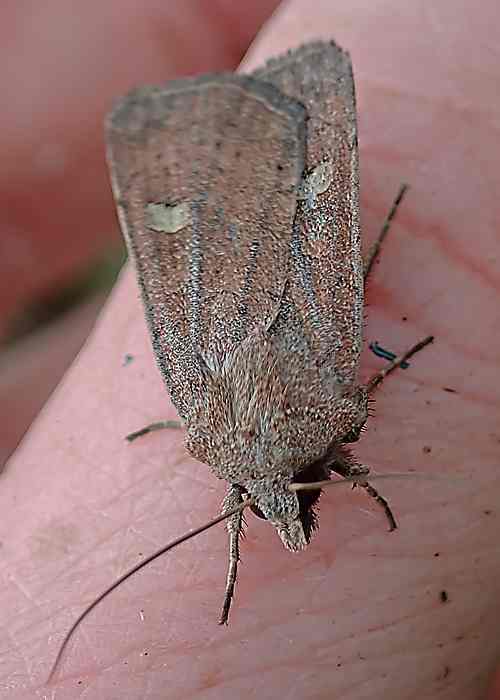
Square spot rustic © Catherine Turner
We heard several buzzard calling insistently and frequently, including one which spent some time on the ground. It was suggested they may have been a family group. A single Great Egret was seen in a distant field close to grazing alpaca. Several Red Kite were spotted flying overhead as were Ravens, Crows and Magpies.
On our return journey the rain had eased and Catherine explored underneath rocks and a tarpaulin, exposing several Invertebrate species, including Ants, a Square Spot Rustic Moth, several examples of Woodlice. Snails, and a Flea Beetle. Spiders including Drassodes (Stone Spider), Clubiona (Sac Spider) and Zelotes, sometimes known as Zipper Spider. We saw two kinds of Wolf Spider, Pardosa and Pisaura (Nursery Web Spider).

Flea beetle © Catherine Turner
Consuming prey in its web was a Tetragnatha, whose common names are Stretch Spider and Long-jawed Orb Weaver.
We came across a Dogwood Bush resplendent with berries. We discussed the abundance of berries on fruit bearing plants following the long, dry summer. Other plants noted were Lady’s Bedstraw, Red Clover, Trefoil, Ragwort and Yarrow.
The walk concluded as it began with a heavy shower of rain.
Catherine Turner
Recent Comments