

Above: Green Elf Cup (Chlorociboria aeruginascens) © Helena Crouch
Leaders: Nathan Orr, Alan Rayner and Helena Crouch
The day of our annual fungal foray dawned misty and autumnal, but the sun broke through as twenty-four members assembled at Stockhill. We were fortunate that Nathan Orr of Mendip Hills National Landscape kindly co-led this meeting and that, after the intensely dry summer, there had been sufficient rain to encourage the growth of fungi.

A troupe of Sulphur Tuft (Hypholoma fasciculare) on a decaying stump © Helena Crouch

Porcelain Fungus (Oudemansiella mucida) © Mike Williams
We found our first specimens at the edge of the car park: a tiny Orange Bonnet (Mycena acicula), a White Fibrecap (Inocybe geophila) and a species of Poison-pie (Hebeloma). Following the Monarch’s Way, we explored under trees finding large patches of Sulphur Tuft (Hypholoma fasciculare) and small tufts of Yellow Stagshorn (Calocera viscosa). On a dead birch we saw several Blushing Brackets (Daedaleopsis confragosa). A smart purple brittlegill with an umbonate cap was identified by Alan as the Humpback Brittlegill (Russula caerulea), mycorrhizal on pines. False Chanterelles (Hygrophoropsis aurantiaca) adorned the forest floor, their deep orange gills distinguishing them from the edible Chanterelle. Nearby, a little grey Snapping Bonnet (Mycena vitilis) was found, soon eclipsed by beautiful turquoise discs along a fallen branch, the fruitbodies of Green Elf Cup (Chlorociboria aeruginascens), the mycelium of which stains wood a bright blue-green.
Continuing, we saw a parade of Candlesnuff Fungus (Xylaria hypoxylon) along a root and found beautiful shining white fruitbodies of Porcelain Fungus (Oudemansiella mucida) on a fallen beech branch: we saw more of these on dead branches high up in beech trees.

Amethyst Deceiver (Laccaria ametystina) © Helena Crouch
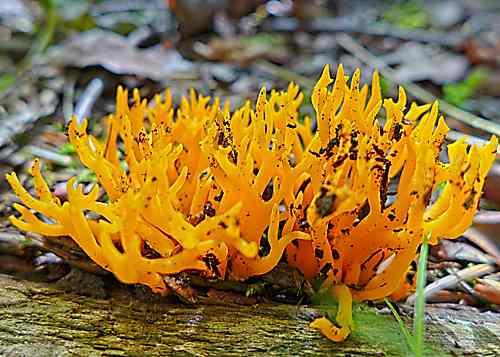
Yellow Stagshorn (Calocera viscosa) on decaying wood © Helena Crouch
We traced the mycelium of Blackedge Bonnet (Mycena pelianthina) through the litter layer of beech leaves and found Brown Rollrim (Paxillus involutus).
We saw several beautiful specimens of the violet Amethyst Deceiver (Laccaria ametystina) and later found the related brown Deceiver (Laccaria laccata).
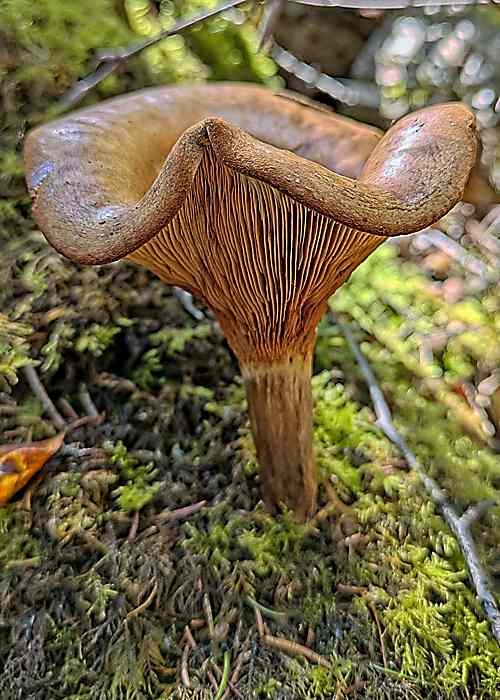
Brown Rollrim (Paxillus involutus) © Helena Crouch

Fly Agaric (Amanita muscaria) © Mike Williams
A stunning red and white Fly Agaric (Amanita muscaria) was admired beside the path, along with egg-like young fruiting bodies, completely encased in a universal veil, which breaks up to leave the white flecks on the cap. Nearby was the related Blusher (A. rubescens): both are mycorrhizal with birch. The tiniest toadstool found was Beechleaf Parachute (Marasmius setosus) on the petiole of a decaying beech leaf. Dainty beige Scurfy Twiglet (Tubaria furfuracea) grew on a twig, and on a fallen beech branch was a group of small hairy white brackets, Splitgill (Schizophyllum commune), a wood-rotting fungus. A few Dusky Puffballs (Lycoperdon nigrescens) were growing nearby.

Scurfy Twiglet (Tubaria furfuracea) © Helena Crouch
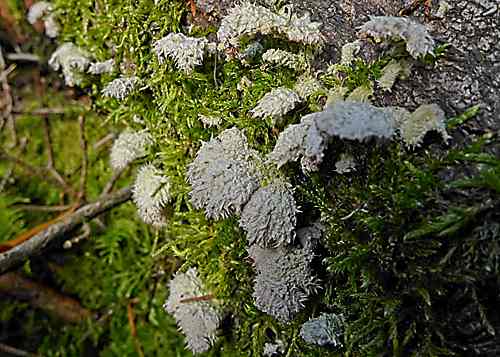
Splitgill (Schizophyllum commune) © Helena Crouch
After lunch on some logs, Alan showed us three different resupinate fungi on one fallen branch: white Jelly Rot (Phlebia tremellosa), the related P. rufa and Pale-yellow Splash Tooth (Mycoacia uda) with the surface covered in spines. We found Earthball (Scleroderma citrina), Butter Cap (Collybia butyracea) and the colourful brackets of Turkeytail (Trametes versicolor).
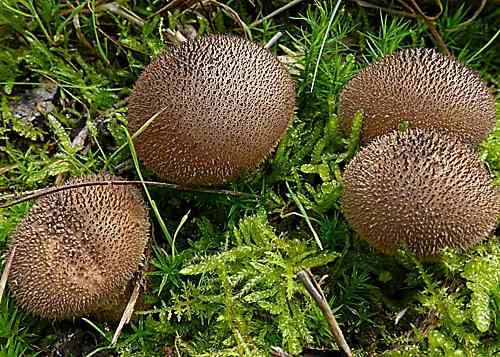
Dusky Puffball (Lycoperdon nigrescens) © Helena Crouch
Black King Alfred’s Cakes (Daldinia concentrica) were sliced to show the silvery concentric rings within. A perfect Shaggy Inkcap (Coprinus commatus) was found, together with a mature specimen dripping black ink. The multicoloured array of fungi, mostly freshly emerged, combined with the expertise of our leaders, made this a hugely enjoyable meeting.
Helena Crouch
Recent Comments