
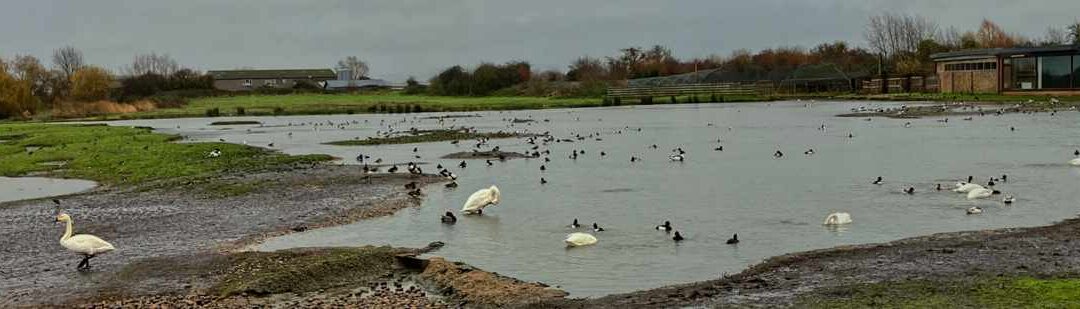
Above: Rushy Pen © Katie Chapman
Leader: Lucy Starling
Seven participants (two pulled out at the eleventh hour) joined Glen Maddison and me at this wonderful WWT centre within an hour’s drive of Bath. With a high tide of 9.00 metres at 9.32am, the Estuary Tower overlooking The Dumbles was our first planned location. But we were halted in our tracks approaching the Willow Hide when Phillip Delve called “Firecrest”. Difficult to see, this tiny bird flitted around about the bottom of a stand pollarded Willows, along with a Chiffchaff, a female Blackcap, Wren and Blue Tit. A Redwing and a Great Spotted Woodpecker at the top of a tall tree were seen by all.
Viewing from the top of the Estuary Tower overlooking The Dumbles, there were large flocks of Canada, Barnacle and Greylag Geese and a single Snow Goose. When the vast numbers of waders took flight, it was quite a spectacle, with the Golden Plover forming a V formation contrasting with the mass of Lapwing and the much smaller Dunlin. Curlew, Avocet and Black-Tailed Godwit lined the river bank. Passerines included Starling and Skylark. The surprise sighting was a fly-by Black Swan of unknown origin.

Lapwing © Philip Delve
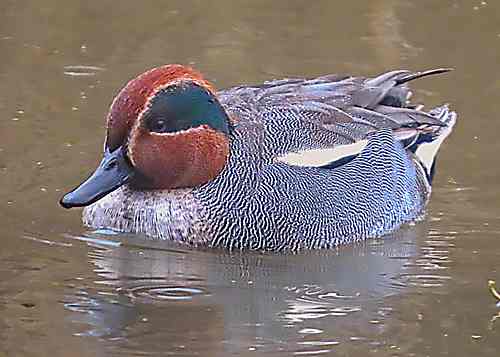
Teal © Andrew Harrison
Our next stop was Robbie Garnett Hide and on the pond we saw several duck species: Mallard, Tufted, Pochard, Shoveler, Shelduck, Pochard and Teal. Redshank and Ruff stood on the water’s edge, occasionally taking flight and calling. Wigeon grazed over a wide expanse of Tack Piece with a few Bewick Swan including a juvenile. This area, partly flooded, was much favoured by Lapwing, Curlew and Golden Plover.
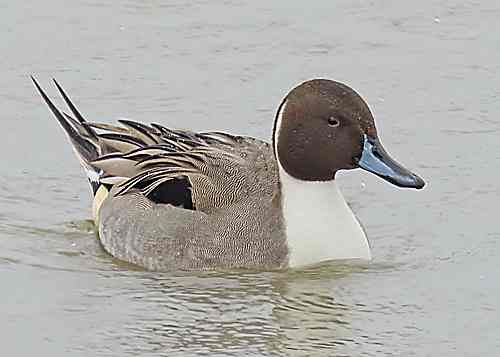
Pintail © Phillip Delve

Bewick’s Swan © Andrew Harrison
Rushy Pen is invariably good for Pintail at close quarters and Bewick’s Swans; it is sad, but not surprising, that Bewick numbers are so low now; a clear indication of climate change and, possibly, impact of avian flu. We took an early lunch about 12 noon in the Peng Hide, adding Grey Wagtail to the Pied seen from Rushy.
Our walk to Zeiss Hide was thankfully dry (after teaming rain an hour or so earlier). The only notable species here was a female Marsh Harrier, who glided into view and disturbed a large flock of Teal. It was then on to The Kingfisher Hide where we added Sparrowhawk, Gadwall, Little Grebe and, perhaps, most exciting, a Fieldfare.
We dropped into South Lake hide briefly before returning to Willow Hide, Robbie Garnett and Estuary Tower, primarily looking for Firecrest again and in hope that the flock of White-Fronted Geese had moved into view somewhere on Tack Piece. Sadly we did not locate either species, nor did we find a Water Rail, but we did see Common Cranes on The Dumbles, Phillip located a Common Snipe, and I spotted a distant Common Buzzard.
Despite the poor weather, the many wintering birds, as ever, were a delight to see and hear and we amassed over 50 species for our 6 hour visit, of which the highlights are recorded here.
Lucy Starling
Recent Comments