
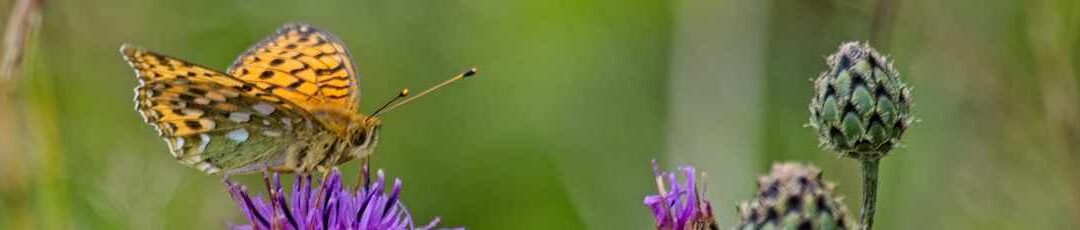
Above: Dark Green Fritillary © David Hall
Leader: Glen Maddison
On a muggy, warm, overcast morning twelve members set off through the top scrub and out onto the open chalk grassland of Martin Down. Immediately we spotted all four Common Whites including recently emerged Marbled. We saw many Meadow Browns and Ringlets and smaller numbers of Brimstones, Red Admirals and Peacocks. All three skippers, large, small and single Essex were also visible.

Marbled White © Richard Bottle

Ringlet © David Hall
At this time of year birding can be disappointing, but after an initial sighting of a Cuckoo flying through from the car park, we were surprised to hear a brief “reel” from a Grasshopper Warbler. We had a brief view of the bird as it flew under cover.
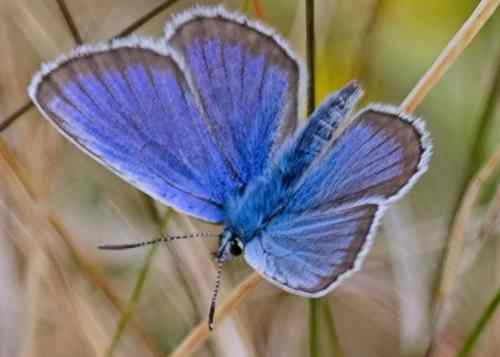
Silver-studded Blue upperwing © David Hall
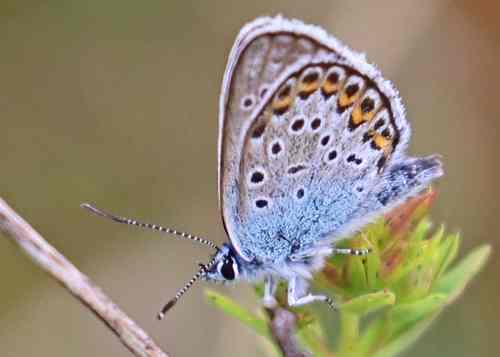
Silver-studded Blue underwing © Richard Bottle
A blue butterfly sat on top of a blade of grass. We thought we were looking at a Common Blue, but the sun came out and opening its wings it revealed itself to be a Silver- studded. Another surprise.

Dark Green Fritillary © Glen Maddison

Blackneck © Glen Maddison
A dozen or so Dark Green Fritillaries were spotted. We followed their flight and attempted a few photos. I found a Blackneck moth tucked away in the tussocks. For many of the group it was a first sighting.
We crossed to the main path and stumbled across the lovely grassy nest of a skylark which contained four eggs. We managed some photos without disturbing them.
We heard Yellowhammers and Corn Buntings, the former being the showier. We observed family groups of Whitethroat and Stonechats flitting around the Hawthorn and Wayfaring trees which dotted the downland. Sadly, we did not catch sight of the increasingly rare Turtle Dove, confirming yet again how this once common farmland bird has declined alarmingly over the past decade or so.
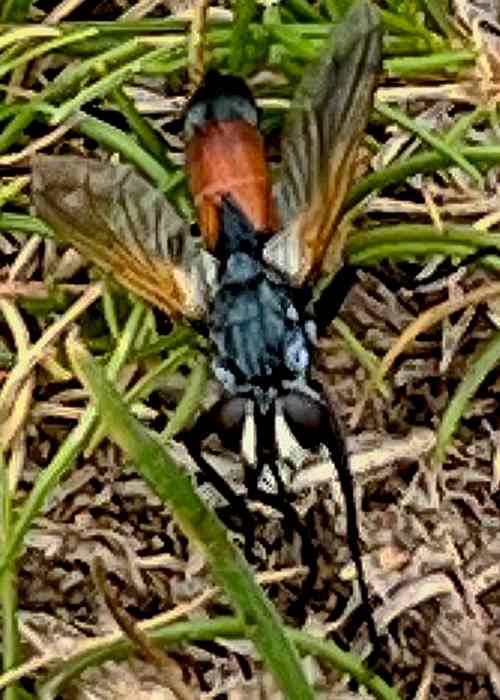
Cylindromyia Brassicaia © Glen Maddison
As the weather became increasingly hot, we headed back to the cars for a lunch break. On the way we saw Six Spot Burnet and Forester Moths. Surprisingly we found a Honey Bee Colony thriving in a gas-terminal box. A strange looking fly, sunning itself on a chalk path took our attention. A few hurried photos were taken and on my return home I contacted a couple of experts, who confirmed it was an extremely rare Cylindromyia Brassicaia which parasites the Hairy/Sloe shieldbug.
After lunch we made our way across the road to the other side of the reserve known as Vernditch Chase, where we wandered briefly over to the pond to see Emperor Dragons and both Southern and Brown Hawkers. Added to our Odonata list were Blue tailed, Common Blue and Large Red Damselflies.
Finally, as we made our way back to the cars we spotted a couple of Silver-washed Fritillaries gliding around the brambles and flowers in the sunnier glades.
It was a great way to finish an excellent field trip.
Birds seen / heard: 44
Butterflies: 20
Moths: 10
Glen Maddison
Recent Comments