
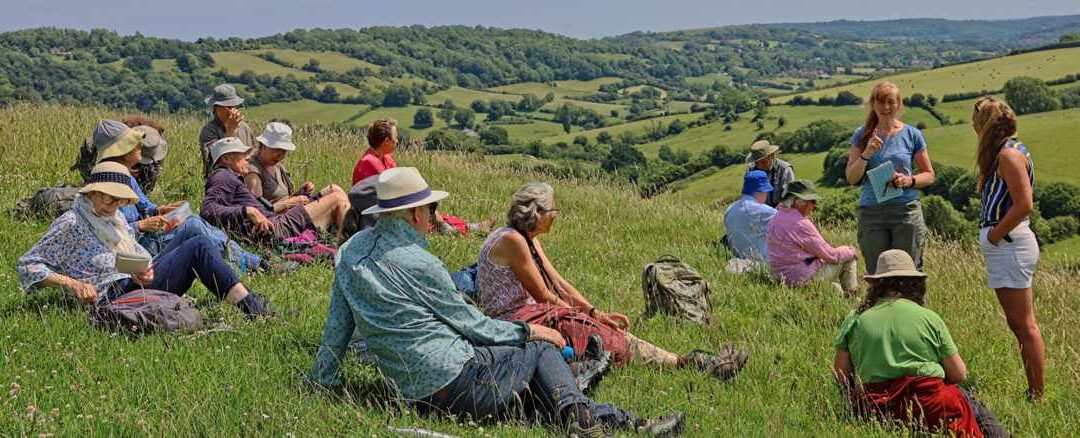
Above: Lunch break at Manor Farm © Richard Bottle
Leaders: Helena Crouch and Laurie MacIntyre
Twenty members arrived at Manor Farm on a sunny day and assembled in the lovely garden for convivial coffee and cake. A bright yellow Goldenrod Crab Spider was admired by some members and a Hornet was spotted. Our host Donald MacIntyre gave us an introduction to the origins and ethos of Emorsgate Seeds, which he established in 1980, before we set off for a tour of the farm.
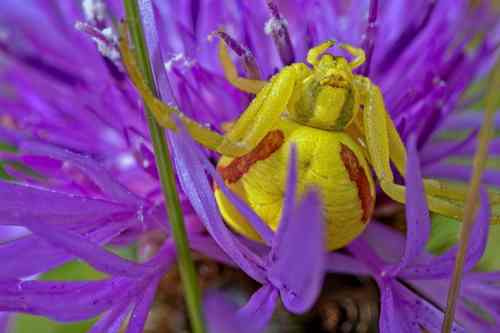
Goldenrod Crab Spider (Misumena vatia) © Mike Williams
Our visit began with an introduction to two majestic Shire horses, part of the herd which are the only grazing animals on the farm. Heavy horses must have been much more common grazers of grassland in the past: their value as conservation grazers is often underappreciated. The meadows at Manor Farm are grazed hard by the Shire horses throughout winter.

Meadow Crane’s-bill (Geranium pratense) with Rough Hawkbit (Leontodon hispidus) and Hogweed (Heracleum sphondylium) © Helena Crouch
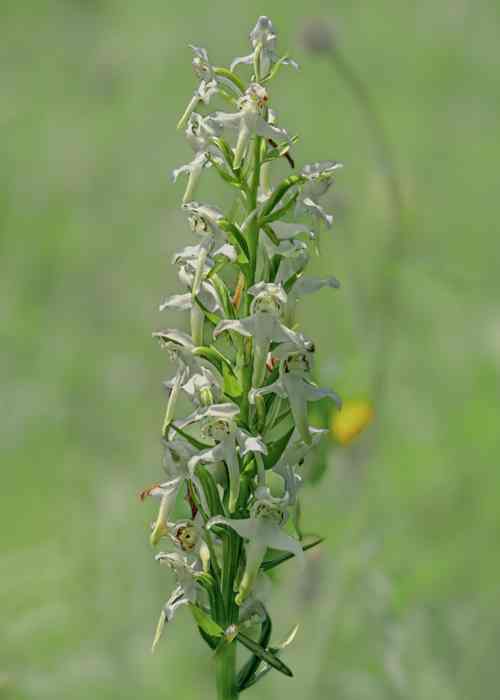
Greater Butterfly Orchid (Platanthera chlorantha) © Mike Williams
The first field we visited was Home Field, where crops of wildflowers are grown for seed collection. Donald showed us machinery used for brush harvesting the seeds. Meadow Crane’s-bill was stunning, in full flower, but the crops are not monocultures since many other wildflowers have seeded amongst them, including several orchid species. We were all delighted to see Greater Butterfly-orchids; some were excited to find a Cricket-bat Spider.
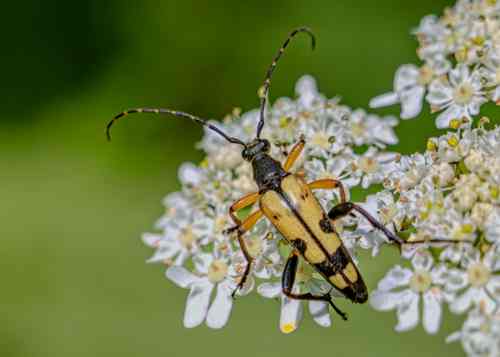
Black-and-yellow longhorn beetle (Rutpela maculata) © Mike Williams
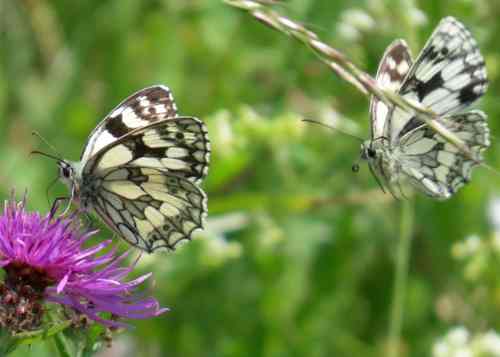
Marbled White on Knapweed © Andrew Harrison
The profusion of wildflowers attracts a myriad of invertebrates. We saw Marbled Whites and Meadow Browns and a Black-and-yellow longhorn beetle. Mike showed us a Downland Bee-fly, ‘dusting’ in bare earth. This formerly rare species is now thriving in the Bath area.
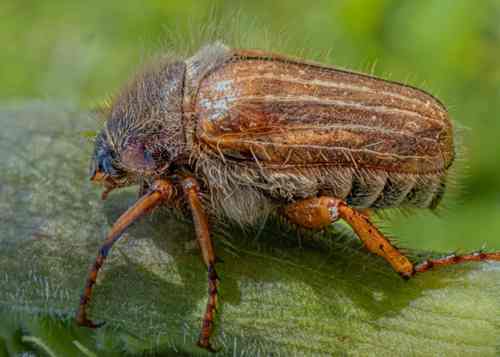
Summer Chafer (Amphimallon solstitiale) © Mike Williams
The serious entomologists were soon left far behind. A Summer Chafer, a smaller relative of the Cockchafer, was found at the southern edge of the field. This species is scarce in the Bath area, requiring unimproved pasture for larval development, and thus an indicator of old grasslands.
Next we visited some fields which have been restored to create species-rich meadows.
Laurie showed us monitoring equipment being used for a study of the biodiversity on the farm. We stopped for lunch at the top of a slope of species-rich downland.
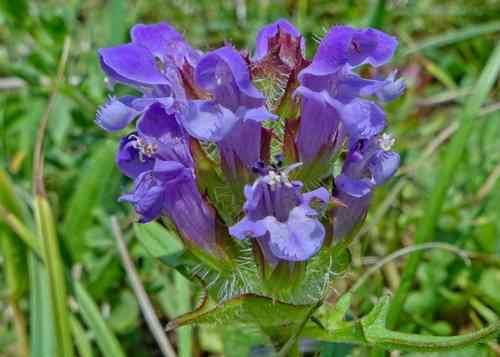
Hybrid Self-heal (Prunella x intermedia) © Helena Crouch
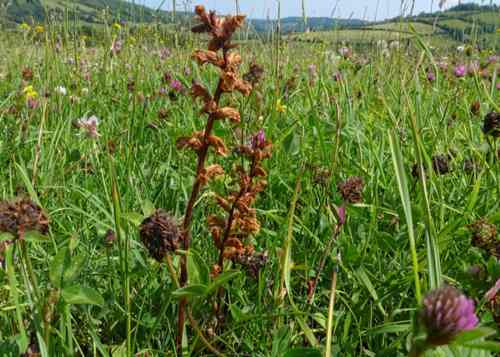
Common Broomrape (Orobanche minor) in a restored meadow © Helena Crouch
Refreshed, we studied the calcareous grassland species, including Fairy Flax, Hoary Plantain and Common Restharrow. We compared the bracts of Small Scabious and Large Scabious, and found seven plants of Prunella x intermedia, the hybrid between Self-heal and Cut-leaved Self-heal. The distinctive raspy call of Stripe-winged Grasshopper was heard: this uncommon species is associated with unimproved calcareous grassland. Meadow Grasshopper and Roesel’s Bush-cricket were also spotted, and a Common Blue butterfly.
Returning to the farm, we saw dead spikes of Common Broomrape. A rather tattered Painted Lady was seen, whilst some admired a Labyrinth Spider. The visit had been an excellent introduction to the work of Emorsgate Seeds with many botanical and entomological highlights. We are very grateful to Donald MacIntyre and Jane and Laurie for kindly hosting us for the day.
Helena Crouch

Home Field, with wildflowers grown for seed collection © Helena Crouch
Recent Comments