
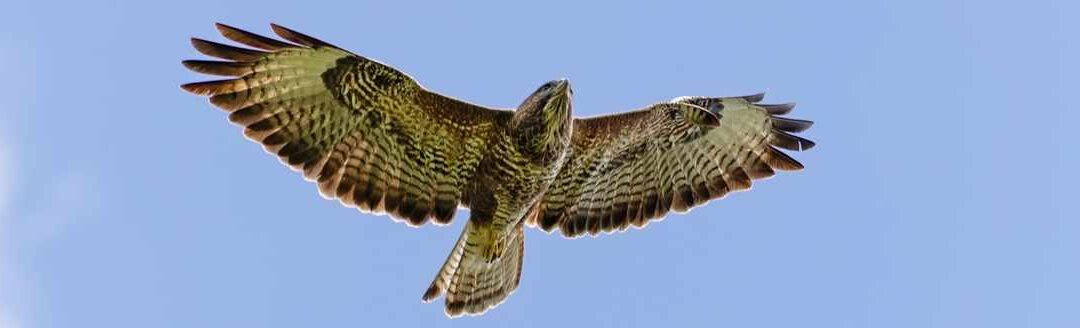
Above: Buzzard Buteo buteo © Claire McCormick
Leaders: Claire McCormick and Alvan White .
Brief History of the site
The 10 acres of land which forms Lyncombe Hill Fields is owned by B&NES. It was bought by the City in 1939, to be preserved as public open space. The purchase came about after a dispute with the land owner at the time, following rejection of his proposal to build houses there. The land was leased for grazing livestock and more recently horses. Since September 2020, it has been managed under licence by the Friends of Lyncombe Hill Fields (FLHF), a not-for-profit Community Interest Company. For more information on the FLHF please visit: https://friendsoflyncombehillfields.co.uk
Eight members enjoyed the sunshine and the wealth of birds and bees on display. Botanic highlights included Cowslips spread around the site and a notably large patch of Alkanet.
The Alkanets proved rich in Bumble Bee activity with my first Early Bumble Bee (Bombus pratorum), recognisable due to being small, predominately black, but with a smidgeon of red on the bottom. This bee has a very short lifecycle and the guidebooks show it being in flight between March and June. Sometime in this period, the new queens remarkably go into hibernation until the following spring when a new colony is started.
The site is being improved for nature with conservation measures. These include stripping the grass top layer and planting Yellow Rattle seed, and further patches seeded with wild flowers. This prompted a discussion about the extra benefit of creating bare patches for mining bees to create nests. Closer inspection revealed the holes created by the females.
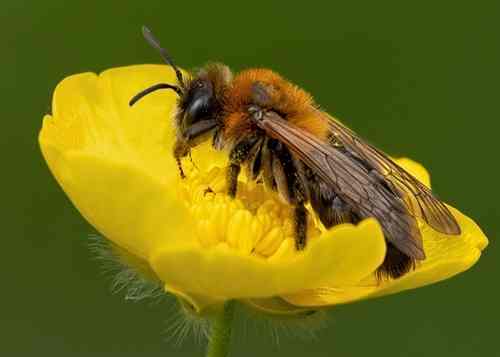
Grey Patch Bee Andrena nitida © Claire McCormick
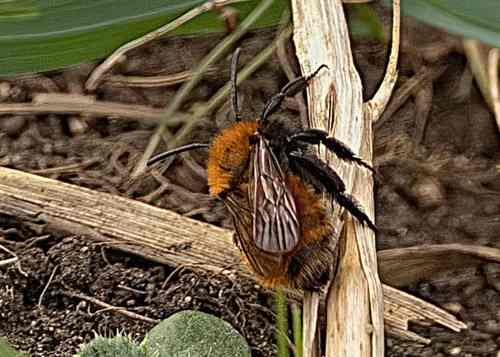
Tawny Mining Bee Andrena fulva © Claire McCormick
Many bee species were on the wing. The solitary bees looked splendid with their hairy ginger thoraxes. Some have incredibly buff or white moustaches and beards. A very close-up photo of one showed white hairs on the side of the abdomen plus the hairy nature of the face. I was therefore able to hazard a guess at Grey Patched Mining Bee (Andrena nitida). However a large number of Andrena (mining bees) are incredibly difficult to split and need to be keyed down and examined with a microscope.
However some are common and, with a practised eye, easier to identify. On the day we found Hairy Footed Flower Bees (Anthophora plumides), and Tawny Mining Bee (Andrena fulva). On the way over Alvan found only his second Spring record so far of Red Mason Bees (Osmia bicornis) sunning on a patch of Ivy and with their orange abdomens glistening in the sunlight.
There is a general bug hotel, but no actual bee hotel. The latter would perhaps encourage other viewable species such as Leaf Cutter Bees (family Megachile). Red Mason Bees are usually common in these.
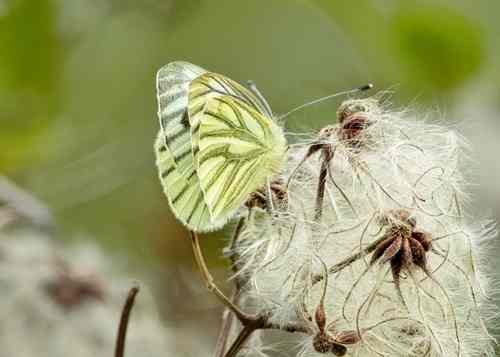
Green-veined White Pieris napi © Claire McCormick
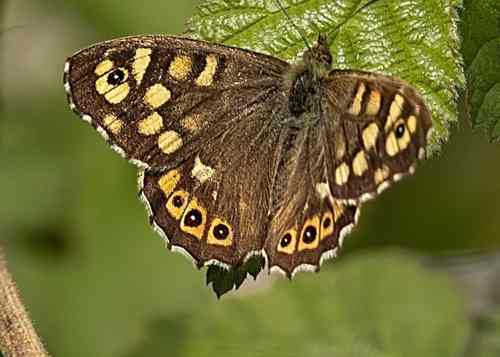
Speckled Wood Pararge aegeria © Claire McCormick
Butterflies on the day were sadly limited to Green-veined White and Speckled Wood. I did a calculation of what could be seen locally at this time of year and came up with ten species.
I mentioned that Alkanet (along with Comfrey) was one of the food plants of the Scarlet Tiger moth. This brought forth that Jersey Tigers (Euplagia quadripunctaria) had been present on site, but later in the summer. Jersey Tigers are perhaps the iconic species of the group, being black, delta winged with striking yellow zig zag markings. It is one more indicator of climate change, there being none present in Bath until about 2020 and indicating a definitive move north.
Bee-flies were very apparent nectaring on the wild flowers. Two common species Bordered (Bombylius major) and Dotted (Bombylius discolor) are now very much in evidence. Since 2001 another relative new comer, the Downland Bee fly (Villa cingulata) has made an appearance. Once thought to be extinct in the UK, it has made appearances locally. However this flies later in the summer and has been recorded in Dorset and Wiltshire.
Ponds
There are several small ponds in secluded areas to provide water for birds and wildlife. Derek very enthusiastically dipped his watertight mobile camera into one and recorded a video. This was essentially to record the noises underneath the water. Please see this third party narrative, https://www.habitataid.co.uk/blogs/blog/sound-pond-life-listen which leads to a recording.The clicks in the recording are given out by the plants respiring and giving off oxygen.
Camera traps placed near ponds have recorded various birds bathing, as well as foxes, badgers, voles and a weasel, with occasional visits from a muntjac deer.
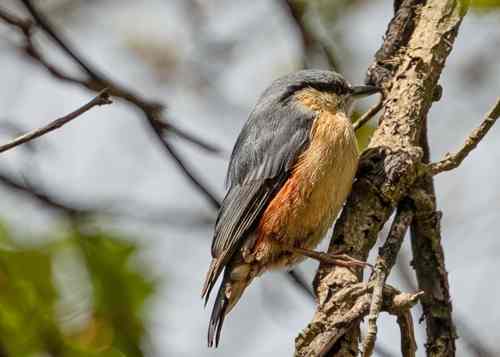
Nuthatch Sitta europaea © Claire McCormick
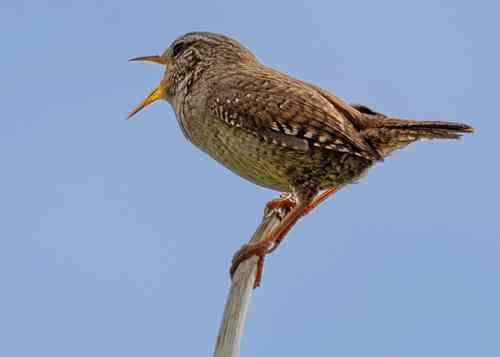
Wren Troglodytes troglodytes singing © Claire McCormick
Birds
A good variety of birds were seen: blue tit, great tit, long tail tit, coal tit, great spotted woodpecker (at nest hole), nuthatch (possibly at nest hole), blackcap, wren, dunnock, goldfinches, chiffchaff, robin, blackbird, magpies, pigeon, buzzard, raven, carrion crow and lesser black backed gull.
Other species such as kestrel, goldcrest, thrush, chaffinch and occasionally willow warbler can be seen at the site in spring and summer, but were not seen on this visit. Siskin and redwing can be seen in winter.
There are 20 bird boxes, mostly for blue tits and great tits, which volunteers monitor for activity across the breeding season.
Grass Cuttings, slow worms and trees
The arisings from grass cutting are often used as mulch for saplings that have been planted since 2020. Approximately 3500 saplings have been planted across three ‘Tiny Forests’ as well as bolstering the hedgerows and field boundaries. A slow worm has been seen amongst the cuttings although none were seen on the day of visit. Hopefully grass snakes will be seen at some point in the future.
Tree Nursery
The site hosts a nursery on behalf of More Trees B&NES, where saplings are grown to be planted elsewhere. There is also a small nursery for growing saplings from seeds collected on site, with the intention that these will be planted on the site.
Thanks especially to Rhua and Claire for providing photographs enabling identifications to be made.
It is hoped that another event run by Claire and Fergus can be arranged for April 2026.
Claire McCormick and Alvan White
Recent Comments