
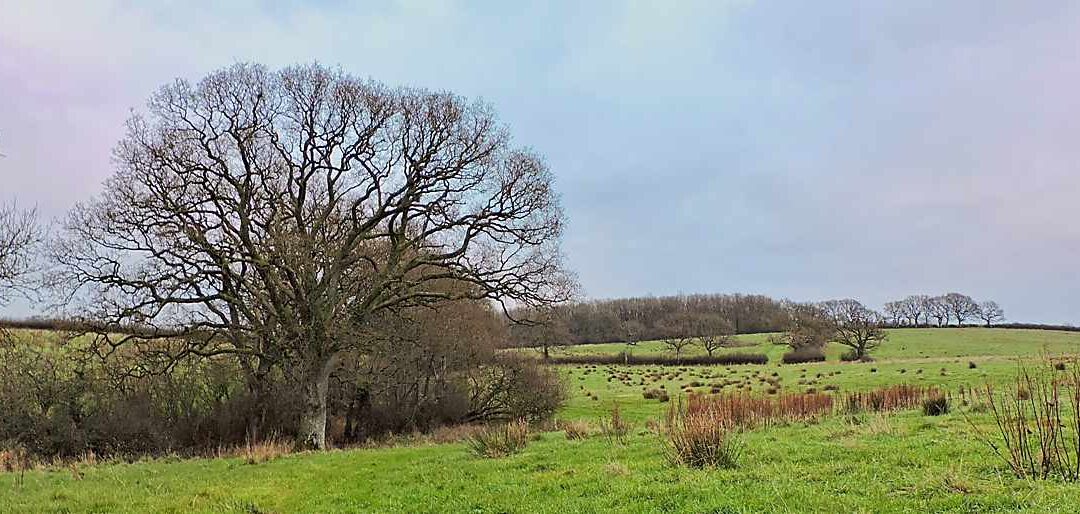
Above: View across the Southern Fields at Heal Somerset © Alvan White
Leader: Daniel Hill (Rewilding Ranger)
Fourteen members were welcomed to the farmhouse on a wintery afternoon with hot drinks and mince pies and an introduction to Heal’s first rewilding site: a 460-acre former dairy farm near Witham Friary. The site includes an array of old barns, some of which will be restored when funding becomes available. Heal’s brave objective is to buy land and rewild it in every county in England. Funding for this vision is raised through sponsorship schemes, donations, ecotourism and events and through Biodiversity Net Gain arrangements with developers.
The introductory presentation included tantalising footage of wildlife seen on the farm. Enthused, we set off for a guided walk around the Southern Fields, led by Rewilding Ranger, Dan. The approach taken for rewilding differs from traditional conservation management in which all activity is aiming to achieve and maintain a particular habitat: here at Heal, nature is being left to shape the landscape and develop functioning ecosystems with minimal intervention.
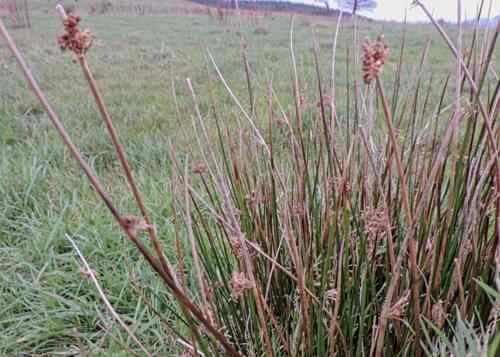
Soft Rush Juncus effusus © Alvan White
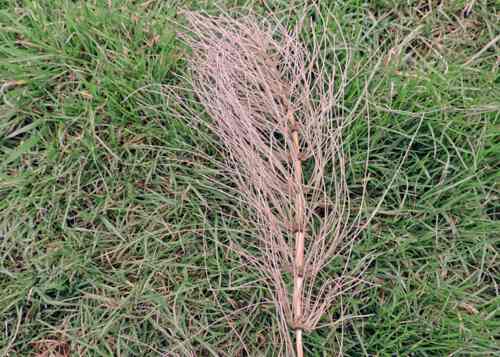
Great Horsetail Equisetum telmateia © Alvan White
As a former dairy farm, most fields were permanent pasture, regularly cut for silage. Since its purchase, the grassland and hedges have been left to grow, although paths are mown to allow access for visitors. Much of the site is naturally wet land, although land drainage was installed in the past. The wet nature of the fields was clear, with many clumps of Soft Rush (Juncus effusus) and patches of Giant Horsetail (Equisetum telmateia). The intention is to disable the artificial drainage, allowing water to remain on-site, resulting in wetter conditions and reducing flooding lower in the catchment area. Other plans include creating ponds and leaky dams, filling in ditches, creation of bunds, and the possible introduction of more willow trees.
In time, some animals will be introduced to the site, but as ecosystem engineers rather than livestock. These may include grazing animals (Exmoor Ponies, sheep, cattle) and pigs (for rootling and disturbance), all acting as proxies for lost or missing wild animals. Once the outer perimeter of the farm is fenced (as at Knepp) then these animals will be able to free roam.
Our visit was quiet in terms of wildlife, although we did see a pair of Roe Deer racing across a field. Bird life was limited to a Stonechat, an overhead Buzzard and some possible distant Mistle Thrushes. The carcass of a deer was pointed out. A camera trained on this has shown scavengers such as Buzzards and Foxes feeding on it. Excitingly a Pine Martin has been recorded on a separate camera. A very small group of Wild Boar were confirmed as being present in the area and Beavers have arrived. We did not view the evidence of the Beavers, to avoid disturbance, but saw wonderful footage in the introductory film.
Bath Nats members have already been involved in surveys at Heal: Alan and Marion Rayner have been recording bryophytes and Helena Crouch is helping with baseline botanical surveys of each field. Although botanical diversity of much of the site is low, the overall list of plants is growing [245 species so far]. Dan showed us some experimental plots where Yellow Rattle has been sown in an attempt to weaken the dominant grasses, allowing other species to colonise. On a visit in April with Catherine Turner, I found the Eastern Fields to be rich in invertebrate life. Helena related that during a survey of some Northern Fields in summer, there were clouds of some common butterflies such as Meadow Browns and Gatekeepers. It is hoped that a summer visit will be made in 2025.
Report by Alvan White
Recent Comments