

Above: Glandular Dog-rose (Rosa squarrosa) © Helena Crouch
Leader: Helena Crouch and Paul & Brenda Dark
This meeting was arranged jointly with Timsbury Natural History Society to explore a site within the recording area of Cam Valley Wildlife Group! Ten naturalists met at the entrance to this Site of Nature Conservation Interest (SNCI) owned by Radstock Town Council. Alongside the entrance path we saw Mugwort (Artemisia vulgaris) and White Bryony (Bryonia dioica). Swifts, House Martins and Swallows were spotted overhead.
Haydon Batch is a colliery spoil tip, the top of which was never planted with trees; species-rich grassland has developed on this nutrient-poor, slightly acidic substrate. Grasses include Sweet Vernal-grass (Anthoxanthum odoratum), Yorkshire Fog (Holcus lanatus), Red Fescue (Festuca rubra), Sheep’s Fescue (F. ovina) on barer areas, and a glistening patch of Downy Oat-grass (Avenula pubescens). There is abundant Bird’s-foot-trefoil (Lotus corniculatus) and hundreds of anthills. Broom (Cytisus scoparius subsp. scoparius) surrounds the site and was in full flower. We saw Green-winged Orchids (Anacamptis morio), now in seed, and puzzled over a pretty rose with red glandular hairs, probably a Glandular Dog-rose (Rosa squarrosa).
Patches of Hard Rush (Juncus inflexus) grow where drainage is impeded. Beside a shallow depression (a seasonal pool) are clumps of Oval Sedge (Carex leporina): the only other sites for this species in B&NES are around Chew Valley Lake and Blagdon Lake.
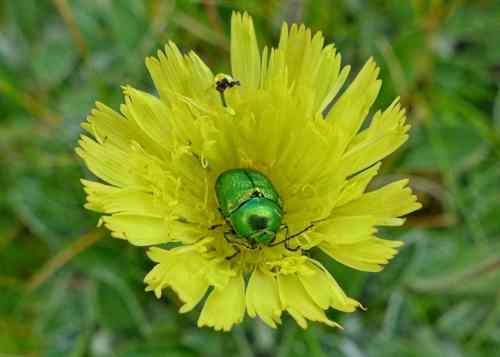
A green Pot Beetle (Cryptocephalus aureolus) on Mouse-ear Hawkweed © Helena Crouch
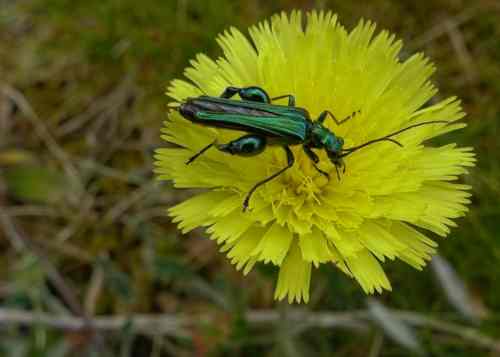
Thick-legged Flower Beetle (Oedemera nobilis) on Mouse-ear Hawkweed © Helena Crouch
On the south-facing slope of the batch, a diversity of herbs flourish on the thin dry soils: volunteers work to keep this area clear of encroaching scrub. Here we saw Mouse-ear Hawkweed (Pilosella officinarum), Woolly Thistle (Cirsium eriophorum) and Small Scabious (Scabiosa columbaria). Insects favour this sheltered slope: butterflies were absent due to the cold wind, but we did spot a Thick-legged Flower Beetle (Oedemera nobilis), the smaller related O. lurida, and a smart green Pot Beetle (Cryptocephalus aureolus).
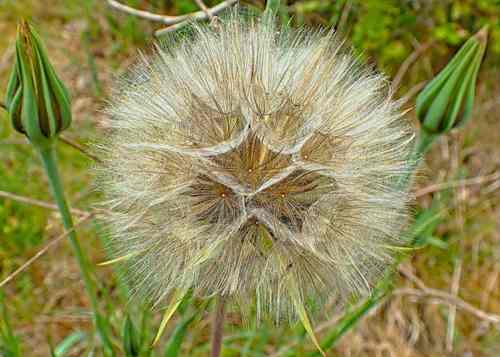
Seed-head of Goat’s-beard (Tragopogon pratensis subsp. minor) © Andrew Harrison
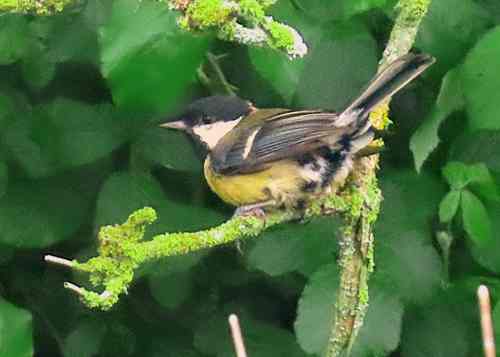
Great Tit © Andrew Harrison
Continuing across the batch, we saw a Great Tit and Green Woodpecker and watched a Kestrel hovering; we also saw Buzzards and a Red Kite. On the west-facing slopes we examined Goat’s-beard (Tragopogon pratensis subsp. minor), also called Jack-go-to-bed-at-noon because the flowers only open in the mornings. It seems they don’t even bother to get up on dull days! After circumnavigating the batch, we heard and saw a Bullfinch, then ascended the batch again for a picnic with a view.
Some participants left after lunch; the remaining five explored adjacent woodland, finding five species of fern: Hart’s-tongue (Asplenium scolopendrium) with simple fronds, Common Male-fern (Dryopteris filix-mas), Golden Scaly Male-fern (D. affinis) and Soft Shield-fern (Polystichum setiferum), all with twice-pinnate fronds, and Broad Buckler-fern (D. dilatata) with thrice-pinnate fronds. Crossing a new bridge, we reached the top end of Waterside Valley, another SNCI, recently purchased by Westfield Parish Council.
Much of the grassland is dominated by species characteristic of enriched ground, such as Nettles (Urtica dioica), Hemlock (Conium maculatum) and Hemlock Water-dropwort (Oenanthe crocata), however there are patches of species-rich grassland with anthills. This area is being managed for wildlife and public use: it is a peaceful valley with great views and historical interest. We returned to the batch, disappointed by the lack of butterflies but glad to have stayed dry while exploring this interesting post-industrial site.
Helena Crouch

Broom (Cytisus scoparius subsp. scoparius) in flower © Brenda Dark
Recent Comments