
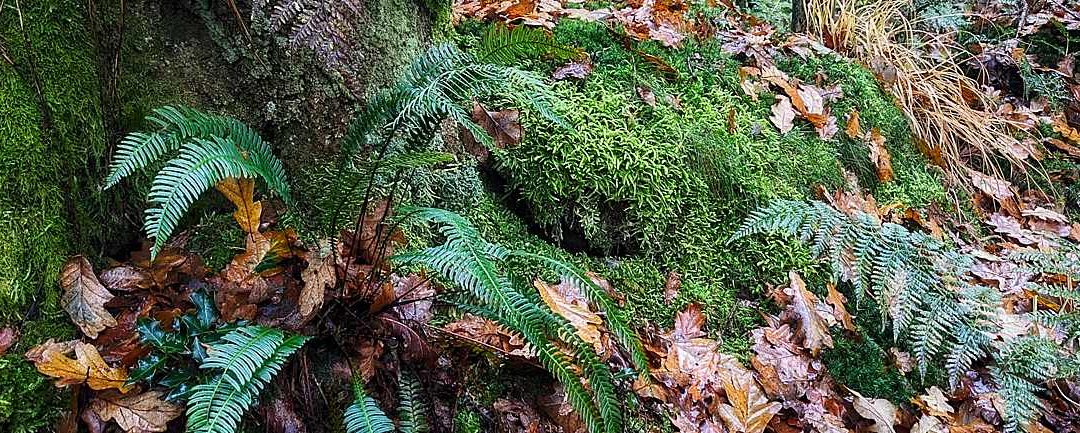
Above: Blechnum spicant and Plagiothecium undulatum on a bank © Helena Crouch
Leaders: Helena Crouch, Marion Rayner and Alan Rayner
Anticyclonic gloom enveloped Mendip as 20 Bath Nats members and a Bath University student (who cycled from Bath) gathered in the Forestry England car park at East Harptree. As we waited, rumours of Crossbills were quickly confirmed as Lucy reported hearing them flying above us.
We started in a small area of beech trees where the glorious autumn leaves hid the ground cover of typical woodland mosses including Polytrichum (formerly Polytrichastrum) formosum (Bank Haircap) complete with tall angular capsules. The bank had a good range of ferns including: Dryopteris filix-mas (Male Fern), Dryopteris dilatata (Broad Buckler-fern) and Athyrium filix-femina (Lady Fern). The large beech tree nearby had a growth of fungus Kretzschmaria deusta (Brittle Cinder) and Meripilus giganteus (Giant Polypore). Shortly we were able to compare the Polytrichum formosum with Atrichum undulatum (Common Smoothcap) where they were found growing side by side, along with a lovely Fissidens species (Pocket-moss) covered in tiny capsules.
We took the path towards the pool and Smitham Chimney, stopping along the way to dive into the woodland on either side to explore for fungi and bryophytes. Helena pointed out the fern Blechnum spicant (Hard Fern) with its separate vegetative and reproductive fronds. Alan found Gymnopus (formerly Marasmius) androsaceus (Horsehair Parachute) with its delicate stipe. Under the trees there were also plenty of luxuriant mosses, including Thuidium tamariscinum (Common Tamarisk-moss) and Pseudoscleropodium purum (Neat Feather-moss).
Progress was slow but as we approached the pool and Smitham Chimney a small group of Crossbills was spotted flying between the conifers and by now we had all had the opportunity to learn their distinctive call.
The damp woodland before the pool was particularly rich in bryophytes, festooning the trees and covering the ground. A search was undertaken for a particularly small liverwort Colura calyptrifolia (Fingered Cowlwort) and it was Fred who managed to locate a tiny patch on a twig, so small that a hastily drawn diagram and good hand lens were needed to help observers appreciate it!
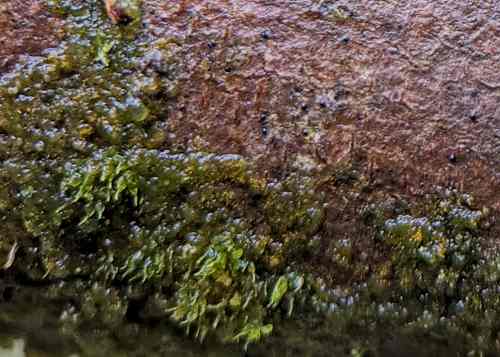
Colura calyptrifolia © Helena Crouch
Here Fred also showed us a large patch of Sphagnum fimbriatum (Fringed Bog-moss) in a damp hollow. We also admired patches of Plagiothecium undulatum (Waved Silk-moss) unofficially known as ‘white worms’ as it shows up amongst other more intensely green bryophytes.
Finally we reached the pond, where the noticeboard had a good growth of Melanotus horizontalis (Wood Oysterling). A lunch spot was found near the chimney and we were entertained by constant flights of Crossbills in the tops of the surrounding conifers, which enabled those with binoculars to get good views.

Trichaptum abietinum on a dead conifer © Helena Crouch
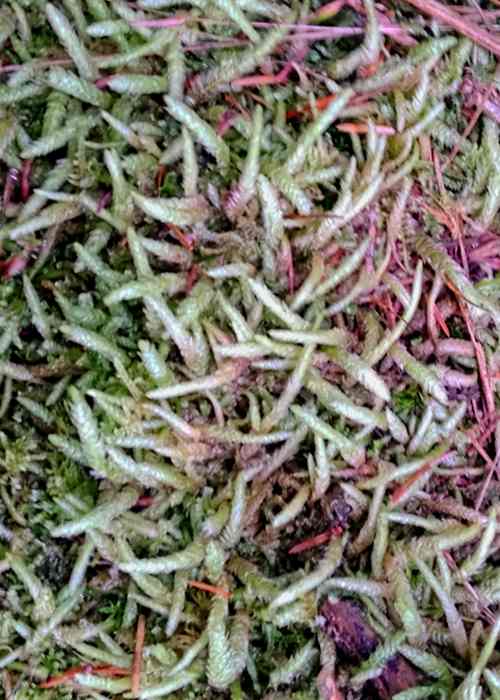
Plagiothecium undulatum Waved Silk-moss © Marion Rayner
After lunch Fred detoured to find the site speciality: Ditrichum plumbicola (Lead Moss) which grows on the highly metalliferous soil of the area, whilst others from the group explored the coniferous plantation woodland where fungi were the stars. A good group of Russula sardonia (Primrose Brittlegill) was found under the trees as well as a perfect Amanita ceciliae (Snakeskin Grisette). On a dead conifer trunk, we admired the velvet-topped, purple-edged brackets of Trichaptum abietinum (Purplepore Bracket).
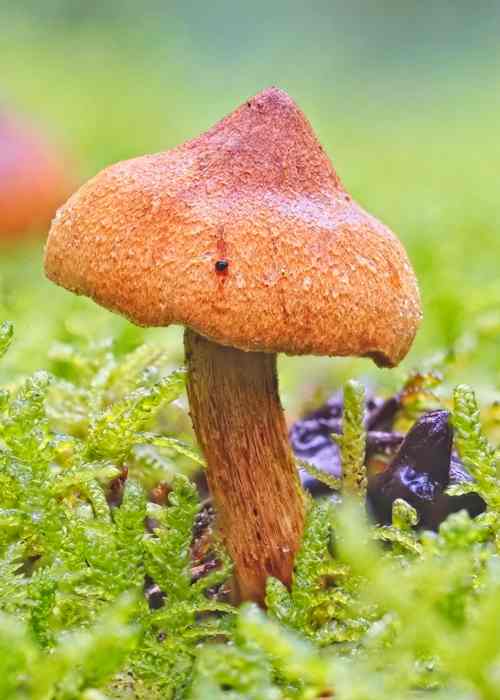
Focus Stacked Deadly Webcap Cortinarius rubellus © Peyton Murphy
Returning to the track we detoured for some bryological tourism as Helena knew of a large rotten log that had an unusual liverwort growing on it: Cephalozia (previously Nowellia) curvifolia (Rustwort) with its red claw-like stems. The nearby wall was spectacularly clothed in cushions of grey lichen (Cladonia sp.).
Further exploration of the coniferous woodland revealed Cortinarius rubellus (Deadly Webcap), fighting for our attention with the Crossbills (seventeen in one tree!) which continued to distract us from the plants and fungi.
Despite the gloomy weather we all had a wonderful day of botany, mycology and ornithology with the added bonus of socialising with old Bath Nats friends whom Alan and I had not seen for some time.
Marion Rayner

Bath Nats members watching crossbills at East Harptree Woods © Marion Rayner
Recent Comments