
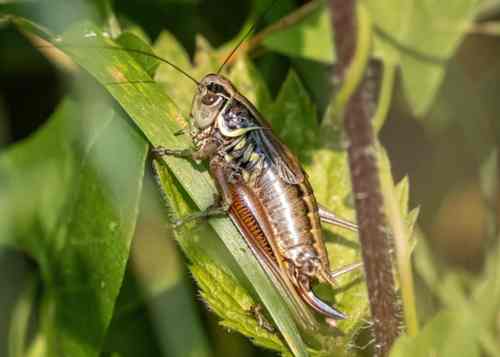
Roesel’s Bush Cricket © Mike Williams
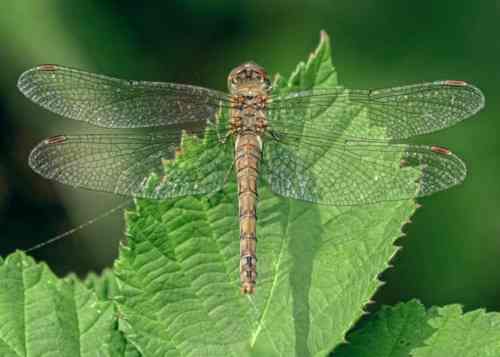
Common Darter © Mike Williams
Responding to a request from the recently-formed ‘Friends of Charlcombe Meadows’ group, members of Bath Natural History Society led a bioblitz of this site on 18th August 2024. Alan Feest tackled the plants, while Mike Williams and Alvan White focused on invertebrates and birds. The day was well-attended, with many of the Friends group and other interested locals interested in our survey.
The site consists of two fields on calcareous soils, the west field lying on Inferior Oolite and the east field mostly on Bridport Sands. There is also a stream that is noted in a Saxon Charter on 1087 running along the eastern and part of the southern boundary. The stream is fed by an interesting calcareous ‘petrifying’ or tufa spring that coats objects in the spring bed in calcium carbonate. There is also a mature hedgerow dividing the fields and encroaching woodland and scrub in the east field.
Sixty species of plants were found on the site, about a quarter of which were common agricultural ‘weeds’, which Alan Feest noted were relics from when the site was grazed, until about 10 years ago. Of particular note, the western field had an abundance of Red Bartsia (Odontites vernus).
Thirty-three species of invertebrates were found, although many more await discovery on the site. No rare species were found, although Mike Williams remarked that it was the first time that he had found Box Bug (Gonocerus acuteangulatus) locally, possibly the first of many. Other species that drew our attention included Figwort Sawfly (Tenthredo scrophulariae), a Four-spot Orb-weaver (Araneus quadratus) which seems to be scarce locally, and a female Common Darter (Sympetrum striolatum). Two species observed on the day are thought to be increasing their range due to climate change – Hornet Hoverfly (Volucella zonaria) and Roesel’s Bush-cricket (Roeseliana roeselii).
All of the birds noted are relatively common locally. Highlights included Buzzard (Buteo buteo), Raven (Corvus corax), Green Woodpecker (Picus viridis) and Great Spotted Woodpecker (Dendrocopos major).
No mammals or reptiles were seen, however a Common Frog (Rana temporaria) was found in the western meadow – no surprise, as the local area frequently features on the local and national news due to a very active amphibian patrol every spring.
The site was deemed to have high potential as a nature reserve in the future with appropriate management, and members expressed an interest in returning there in the future to see what else they could find.
Thanks to Mike Collins of the Friends group for getting in touch. The full survey report can be found here: https://www.researchgate.net/publication/383490880_Charlcombe_Meadows_Bioblitz
Mike Williams
Recent Comments