
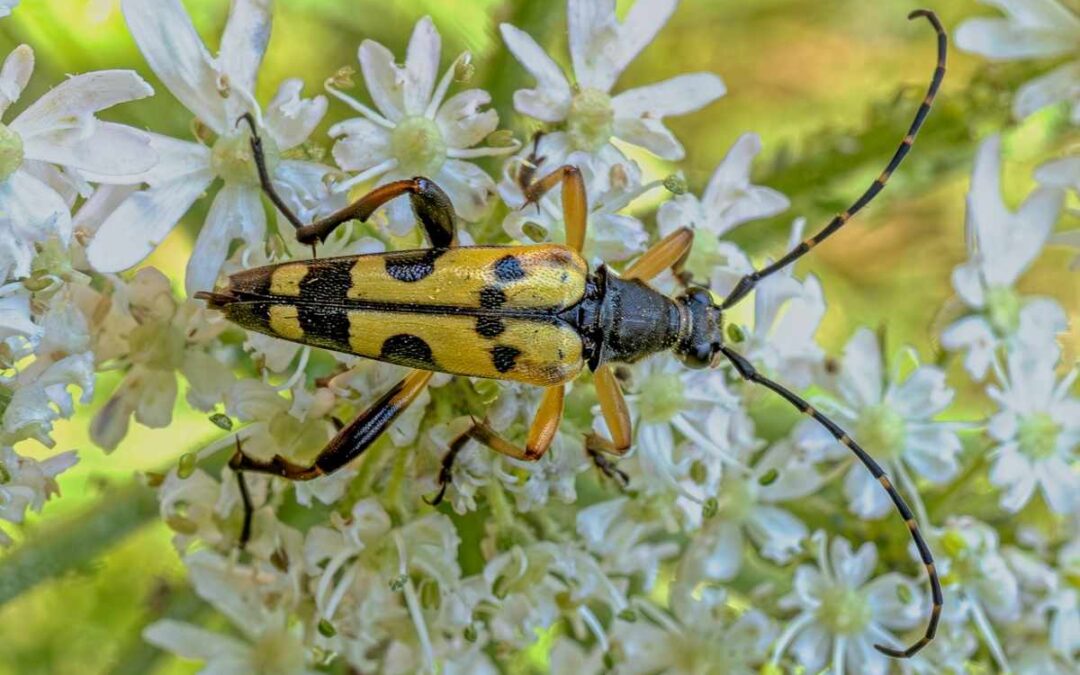
Above: Black and Yellow Longhorn Beetle (Rutpela maculata) © Mike Williams
Leaders: Carole Catling, Helena Crouch, Mike Williams & Alvan White
As a contribution to the 2025 Festival of Nature, members of BNHS supported the Friends of Charlcombe Community Nature Reserve with their Nature of Charlcombe event. The Friends work in partnership with B&NES to manage two fields off Charlcombe Way, Bath. The day began with the opening of a moth trap, followed by an informal drop-in session exploring the reserve, and in the afternoon, a guided wildlife walk.
A moth trap was set up overnight in a nearby garden then taken to the site for opening at 9am by Carole. 28 species were recorded, with a total of 57 moths. It was a successful public engagement session, with a lot of interest and many questions. Visitors were able to closely examine the moths, which were either in pots or nestling on egg boxes. At the end of the session, any remaining moths were released into nearby vegetation.
For the drop-in session, Mike Collins of the Friends of Charlcombe Community Nature Reserve explained how the reserve is managed whilst Helena and Mike demonstrated the diversity of plants and invertebrates on the site. We recorded all plants found, but focused on studying members of a few families. Seventeen species of grass were identified in the western field. We compared several members of the Pea family (Fabaceae), including Red Clover. White Clover, Common Vetch, Bush Vetch, Bird’s-foot-trefoil and Meadow Vetchling. Insects included good numbers of the Black and Yellow Longhorn Beetle, along with Marbled White, Roesel’s Bush-Cricket and Southern Hawker. A Common Toad was also found under a reptile mat – Charlcombe is renowned for its amphibian populations.
Entering the eastern field (Mudcombe), we explored the woodland alongside a stream, finding Sanicle, Pignut, Marsh Marigold, Hemlock Water-dropwort and Great Horsetail.
For the guided walk in the afternoon, we followed the same route around the eastern field, heading downhill through the open grassland area of Mudcombe.

Downland Bee-fly (Villa cingulata) © Mike Williams
Here we saw Lady’s Bedstraw, Knapweed, Red Bartsia and Greater Bird’s-foot-trefoil. In woodland by the stream, participants were shown how to distinguish five different species of fern. Altogether we recorded 118 species of plants. Good numbers of the Downland Bee-fly were noted. This species was presumed extinct in the UK until 2001, but in recent years has dramatically increased around Bath – Mike now considers it a common species!
Other highlights included the large horsefly Tabanus bromius, Hornet Hoverfly, a yellow Flower Crab Spider, Thistle Ermine and some large Peacock caterpillars.
The sessions included discussion on insect identification, research on insect migration, and insect life histories. Species such as Downland Bee-fly, Roesel’s Bush-cricket and Hornet Hoverfly have greatly expanded in range over the past 25 years and would not have been present here at the turn of the millenium. It was good to connect to members and non-members who would not normally attend due to work commitments etc. in mid-week. The knowledgeable 10 year old budding young naturalist was a rare addition to the mix.
Helena Crouch, Carole Catling, Mike Williams and Alvan White
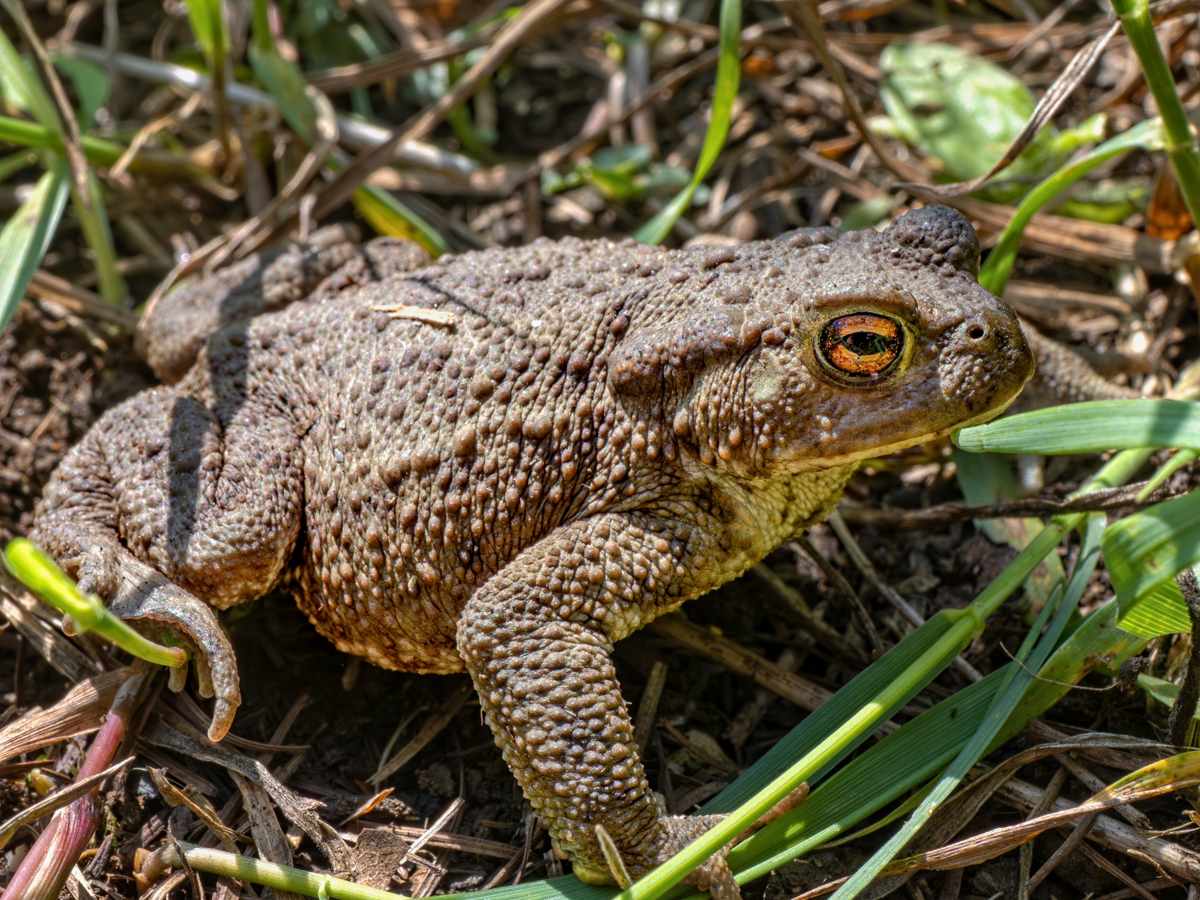
Common Toad (Bufo bufo) © Mike Williams
Recent Comments