
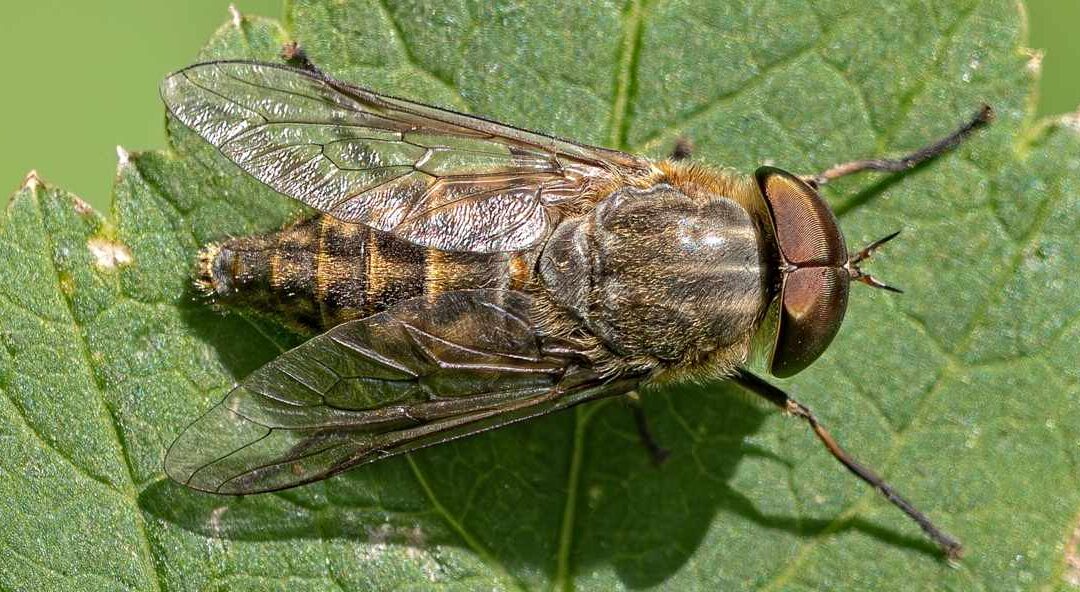
Above: Band-eyed Brown Horsefly © Mike Williams
Leaders: Alvan White and Mike Williams
The start of another heatwave with lots of sun and a blue sky, the temperature was projected to reach reach 26°C, and indeed it did.
At the car-park, we found an abundance of Band-eyed brown horseflies (Tabanus bromius), a fairly large fly, enjoying the heat off a car. Mike explained that only the females are blood feeders, apparently usually targeting cattle although Mike has also found them around pigs and also in areas with no livestock, where lunch might be deer blood. They occasionally bite humans, but more rarely than the Common Cleg – they were not interested in us. The blood is required by the females for egg production.
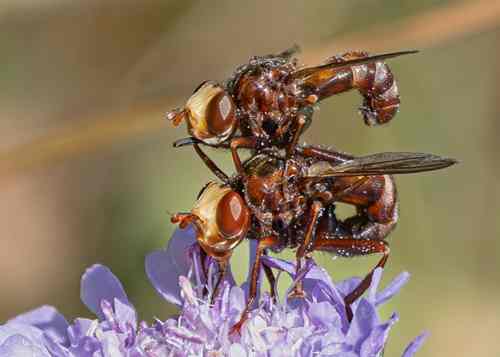
Mating Ferruginous Bee-grabbers © Mike Williams
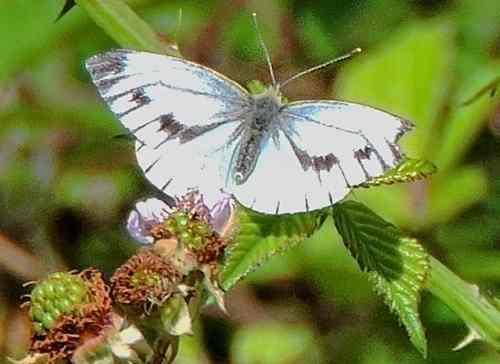
Green Veined White (Pieris napi) © Alvan White
Green-veined White, Peacock, Red Admiral and Large White were seen. We noted the scalloped shape and comma-marking on the underwing for the Comma butterfly. Black-and-yellow Longhorn Beetles were also seen on the Bramble flowers.
At the edge of the quarry area, we witnessed a quick fly-by of a Silver-washed Fritillary and a pair of mating Ferruginous Bee-grabber (Sicus ferruginous) flies. These flies are members of the Conopidae (thick headed flies), and are endoparasites of bumblebees. Females wait on flowers and oviposit on the hosts. We heard the calls of Roesel’s Bush-cricket and Stripe-winged Grasshopper.

White-flowered Marsh Thistle © Mike Williams
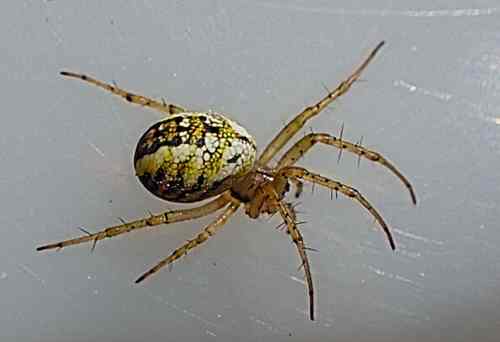
Cricket Bat Spider (Mangora acalypha) © Alvan White
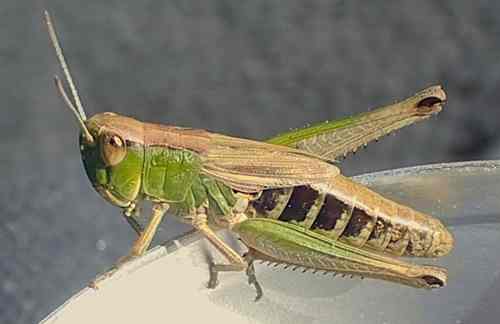
Meadow Grasshopper (Pseudochorthippus parallelus) © Alvan White
Birds were in short supply. Seen and heard were Blackbird, Blackcap, Chiffchaff, Buzzard, and Bullfinch. Ravens were seen soaring together.
Many species of limestone wild flowers were evident including Common Valerian, Harebell, Wild Marjoram, and an unusual pair of white-flowered Marsh Thistles. In the woods we found Wild Parsnip and Wild Basil.
Sweep-netting revealed a Cricket-bat Orbweaver spider and a minute juvenile Ozyptila sp. spider, alongside Meadow Grasshopper and capsid bug species.
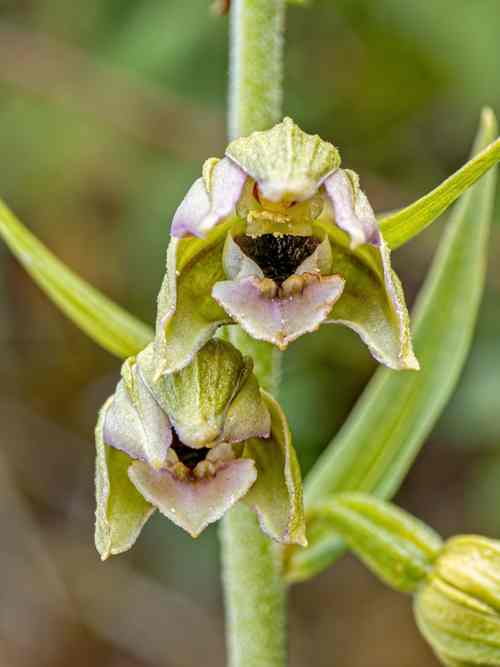
Broad-leaved Helleborine © Mike Williams
Lunch was taken in semi-shade close to a pair of goats. Here we admired the far-reaching view beyond Stantonbury, to the slopes of Dundry Beacon, just behind Bristol.
Mike then led the way towards the bottom of the slope to a group of 10 Broad-leaved Helleborine flower spikes, with the lower buds just starting to open.
He mentioned that the quarry slopes had earlier been covered in other orchids, including large numbers of Common Twayblade and Common Spotted, but sadly not Fly Orchid, previously recorded here, despite a thorough search.
A Green Tiger Beetle was sighted on the upwards pathway.
While resting on the northern edge of the quarry, a female Silver-washed Fritillary constantly came back to the same spot, potentially a territory established by the butterfly – but would be unusual in females.
A very steep climb took the party up to Brown’s Folly itself. Behind the Folly, some Hogweed was in full flower and had attracted a range of insects. Within the crowd, there was a female Gasteruption sp. (a parasitic wasp), demonstrating her large ovipositor. More on the remarkable life history of these wasps can be found at https://nurturing-nature.co.uk/wildlife-garden-videos/gasteruption-jaculator-and-the-hylaeus-bee-battle/lease
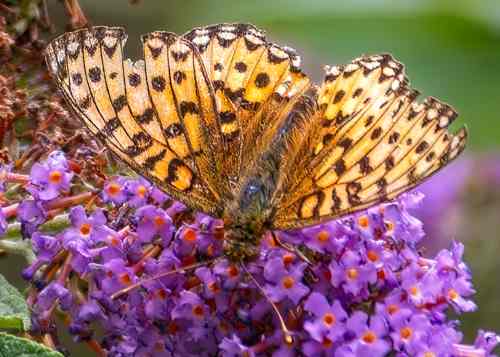
Dark Green Fritillary © Mike Williams
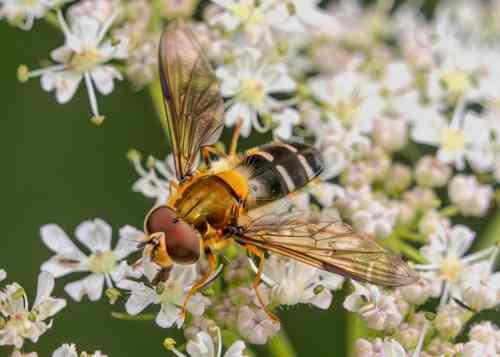
Leucozona glaucia © Mike Williams
Moving on, study was given to the butterflies in a group of Buddleja bushes. Mike then found the star of the show. No underwing markings could be seen, but silver markings on the outer rim of the rear wings, u markings on the inner fore wings, plus only a single line of black spots on the rear wings pointed to a Dark Green Fritillary. In a recent Bath Nats talk, Maurice Avent said he thought this species was declining due to the cessation of periodical felling in woodlands – the recent felling of Ashes at Brown’s Folly has potentially benefitted this species.
Downland Bee-fly and the hoverfly Leucozona glaucia were highlights at the woodland edge, by an arable field.
A good selection of wildlife was encountered, with about 15 butterfly species, including Common and Holly Blue.
Further information on the site, can be found at www.avonwildlifetrust.org.uk/
Mike Williams
Alvan White
Recent Comments