
Leader:David Westgate
This was a follow up evening from the previous visit to Elm Farm on May 19.
There were nine of us, including our host Philippa Paget, and leader David Westgate of Avon Bat Group.
After an introductory talk from Philippa and a demonstration of echo location from David, we looked inside a barn for evidence of bat activity. Piles of droppings indicated bat presence. The droppings are very small, similar to mice droppings but they are very dry and become powdery dust when rubbed. There are over 60 Natterer’s bats which roost here and barns are ideal habitats for them. As different species emerge at different times after dusk, we returned later to both echo locate them (40-50 KhZ) and watch them flying out.
Prior to that, we visited another location in Burnett where 17 Lesser Horseshoe bats, including young, were roosting. We could echo locate them on their very high frequency of c. 110 kHz and see them flying out. They ‘light-sample’ first, checking light levels and temperature before flying out. This is typical behaviour for them as they want to optimise timing for highest probability of insects.
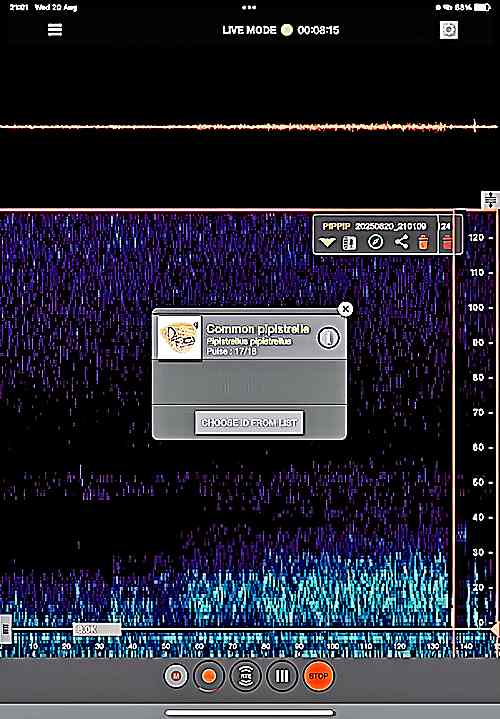
Screenshot from iPad while using Echo Meter device © Carole Catling
We were able to see and echo locate a variety of bats, including Common and Soprano pipistrelles. We used both basic heterodyne and Echo Meter detectors. With the latter, it is interesting to see the different shapes of bat calls : the Natterer’s bats show long, thin, solid, vertical lines and the pipistrelles show a hockey stick (or tick) shape. This is good to know as it is another cross-check to identify the bat.
It was a most enjoyable and very interesting evening, and we were rewarded with plenty of bat activity.
Carole Catling
Recent Comments