
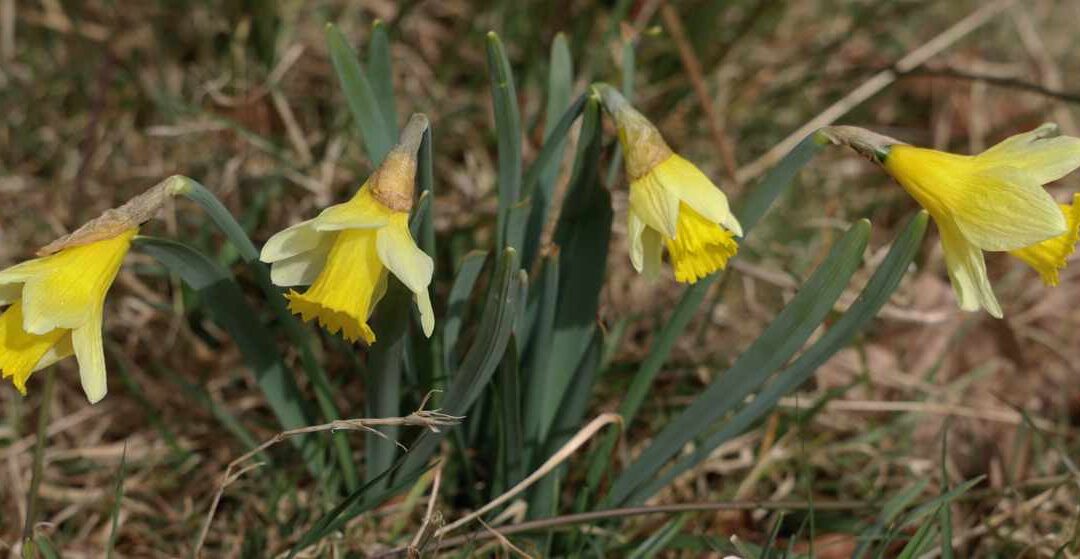
.Above: Wild daffodils on Park Hill Camp © Richard Bottle
Leader: Felicity Gilmour
Fourteen members assembled in the Alfred’s Tower car park on a bright and sunny day. A spell of dry weather had fortunately dried up the mud that had been a feature of walks in the countryside throughout the winter, and we were looking forward to enjoying a mud-free spring walk on part of the Stourhead estate.
We started by admiring the massive triangular Tower which is a folly built around 1770 for the banker, Henry Hoare, as part of his landscape design for his estate. It commemorates the mustering of King Alfred’s troops before the battle of Ethandun (possibly Edington) in 878.
We turned our backs on the Tower and passed an open field where Woodpigeons and corvids were feeding peacefully on the ground, as we headed into the managed woodlands. Here we were greatly helped by Helena’s expertise in identifying the different species of coniferous trees planted. I must admit that to me, although I could see that the shapes are different, I hadn’t appreciated the variety: Western Hemlock, Western Red Cedar (identifiable by its pineapple smell), Douglas Fir, Sitka Spruce and Norway Spruce.
There was plenty of gorse in flower, and great excitement when we spotted a Dandelion (!) although I was somewhat crestfallen to learn that there are around 250 species of this commonly overlooked and often reviled wild flower.
As far as birds were concerned, it was easier to hear them than to see them. The tree cover meant many were elusive, so we were grateful to Lucy and other listeners in helping with identifications. Most were the usual suspects: Song Thrush, Robin, Blue Tit, Great Tit, Goldfinch, Coal Tit. Lucy also spotted a small group of Siskins and drew our attention to a calling Stock Dove.
Buzzard and Red Kite were the only raptors seen.
At Park Hill Camp, an Iron Age hillfort, we were delighted to find that the wild daffodils, which I had despaired of seeing, were there waiting for us. The recent sunny weather perhaps encouraged their emergence. Once we had identified them amongst the grasses, they seemed to be everywhere, and we spent time admiring and photographing them, while trying to avoid treading on them.
I wondered if the resident flock of Exmoor Horn sheep might have nibbled them, but was informed that the daffs are poisonous so presumably are avoided.
As we circled back round the Fort, mouse-like Wrens were spotted dodging in and out of the bramble bushes and two Great Spotted Woodpeckers were seen flitting (flirting, or maybe fighting) high up in the tree canopy. Anne identified one positively as a male, but we were not sure about the other.
Apart from the daffs, flowers were in short supply although we could see the bright green spikes of bluebell leaves emerging around the fort, and Helena spotted Barren Strawberries on the way back to the car park, their dainty white flowers barely visible in the grass.
An enjoyable walk with the usual good company and sharing of knowledge amongst the participants.
Felicity Gilmour
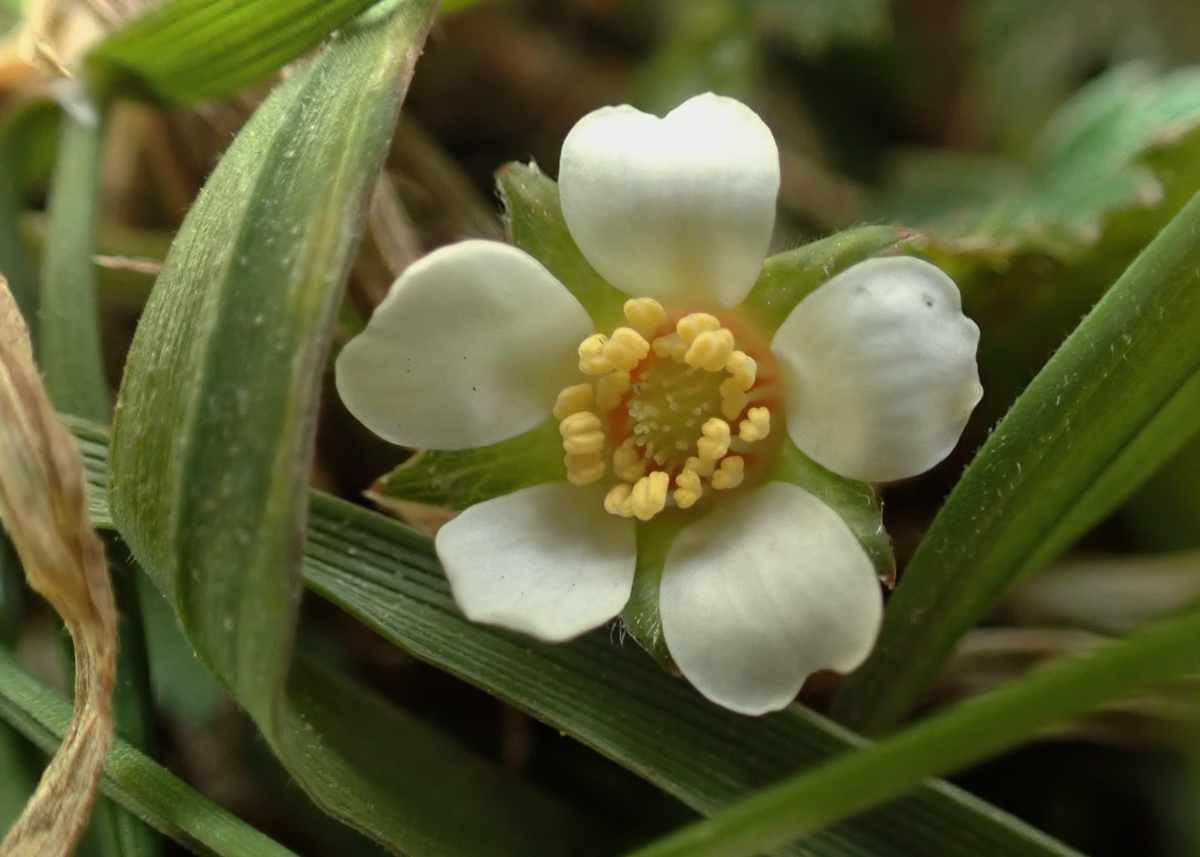
Barren Strawberry © Andrew Harrison
Recent Comments